
Key takeaways
- Outbound shipping runs about 8 to 15% of revenue gross for most ecommerce brands in 2026, and well-run operations hold net shipping inside 5 to 10%.
- The number that matters is net shipping, your shipping expense minus the shipping revenue customers pay: a brand spending $11 to ship and charging $7.95 has a net cost of $3.05 per order, not $11.
- Shipping cost as a percentage of revenue is a proxy for average order value: the same $10 parcel is 25% of a $40 order and 6% of a $180 one.
- Free shipping puts the full gross cost on your P&L, so a threshold only protects margin when it sits above the order value where the order still clears its variable costs.
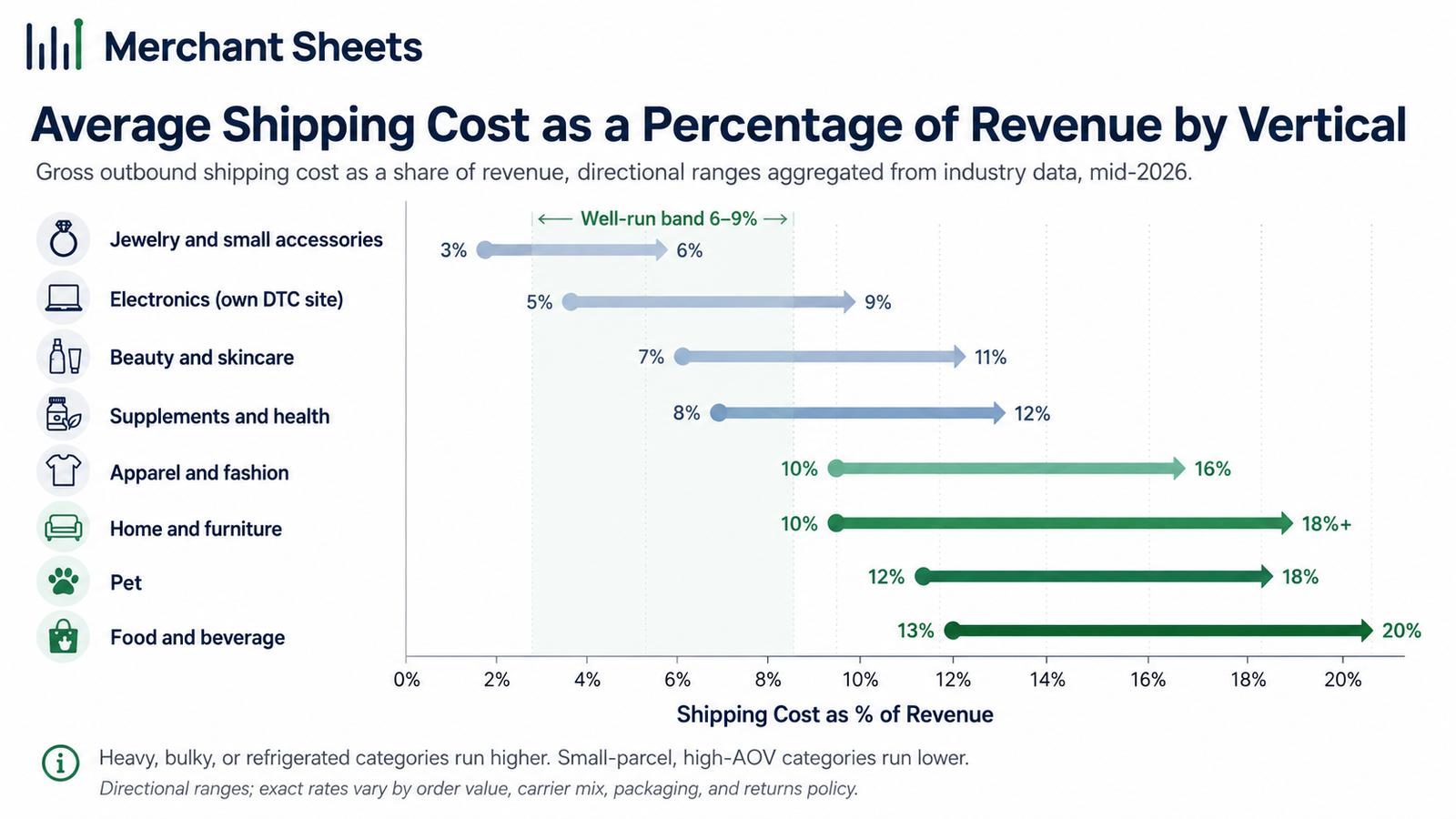
- By vertical, light high-value categories like jewelry and electronics run leanest at 3 to 9%, while heavy or refrigerated categories like food and beverage run 13 to 20%.
Shipping runs about 8 to 15% of revenue for most ecommerce brands in 2026, but shipping cost as a percentage of revenue is misleading on its own. The same $10 parcel is 25% of a $40 order and 6% of a $180 one, and the number drops fast once you subtract what customers pay you at checkout.
Below are the 2026 benchmarks by vertical and by shipping policy, the gross-versus-net gap that most published figures skip, and the one ratio that tells you whether yours is healthy.
Track it alongside your other ecommerce KPIs and shipping stops being the line that quietly eats your margin.
What’s the average shipping cost as a percentage of revenue?
Outbound shipping costs about 8 to 15% of revenue for a typical ecommerce brand in 2026, with light small-parcel categories near the bottom and heavy or refrigerated ones near the top. Top operators hold it around 6 to 9%. The figure to compare is your total outbound shipping cost divided by your revenue over the same period.
The formula is straightforward: shipping cost as a percentage of revenue equals total outbound shipping cost divided by total revenue. Two things trip people up before the math even starts.
First, scope. Outbound shipping is one line inside all-in fulfillment cost per order, which also covers pick and pack, packaging, and storage. This page benchmarks the outbound shipping line, the money you hand carriers to move a parcel to the customer.
Second, gross versus net, which is big enough to get its own section. This page benchmarks outbound shipping as a percentage of revenue, as of mid-2026.
Gross vs net shipping cost
Most published shipping benchmarks quote gross expense and ignore the shipping revenue customers pay at checkout. That’s the single biggest reason two brands with the same carrier bill look nothing alike on paper.
Net shipping cost is your shipping expense minus the shipping income you collect. A brand spending $11 to ship an order and charging a $7.95 flat rate carries a net shipping cost of $3.05, not $11.
The brand next to it that ships free carries the full $11. Same parcel, same carrier, a 3.6x difference in what actually hits the P&L.
Table 1: Gross shipping cost vs net shipping cost, two brands with the same carrier bill (illustrative, as of mid-2026).
| Scenario | Shipping expense / order | Shipping income collected | Net shipping / order | Read |
| Free shipping, $60 order | $11 | $0 | $11 | Full gross cost lands on you; about 18% of the order |
| Charge actual, $60 order | $11 | $7.95 | $3.05 | Mostly recovered; about 5% of the order |
| Free over $75, $90 order | $13 | $0 | $13 | Threshold above cost helps, but the order still carries $13 |
| Flat $5, $60 order | $11 | $5.00 | $6.00 | Partial recovery; you absorb the $6 gap |
Net shipping income against expense before you compare yourself to any benchmark. If a figure you read online is gross and yours is net, you’ll draw the wrong conclusion in either direction.
Free-shipping brands carry the full gross number by design, which is exactly why their percentage looks high next to a brand that charges at checkout.
Shipping cost as a percentage of revenue by vertical
What you sell sets the range more than how you sell it. Weight, box size, fragility, and average order value move the percentage far more than any carrier discount.
Table 2: Typical shipping cost as a percentage of revenue by ecommerce vertical (gross outbound, directional ranges aggregated from industry data, as of mid-2026).
| Ecommerce vertical | Typical shipping % of revenue | Why |
| Jewelry and small accessories | 3–6% | Tiny and light with high order value; parcel cost is a small slice, although adding insurance can change this. |
| Electronics (own DTC site) | 5–9% | High order value absorbs protective packaging and higher-value parcels |
| Beauty and skincare | 7–11% | Small parcels, but liquids and glass add weight and protection |
| Supplements and health | 8–12% | Compact and often subscription, at a moderate order value |
| Apparel and fashion | 10–16% | Light to ship, but high return rates make you pay to ship twice |
| Pet | 12–18% | Heavy food and litter against a mid order value |
| Home and furniture | 10–18%+ | Heavy and bulky with dimensional-weight surcharges, offset by high order value |
| Food and beverage | 13–20% | Weight, damage risk, and cold-chain or insulation stack up |
Read the table against what you ship. A supplements brand shipping small, dense bottles lands near the bottom, while a beverage brand shipping heavy, breakable, temperature-sensitive cases sits at the top.
Apparel looks light but pays a returns penalty, because a returned order pays to ship out and back, which is tracked in the return rate.
How free shipping changes the number
Your shipping policy is the second axis, and it decides how much of that gross cost you ever get back. The same order can carry four very different net numbers depending on who pays.
Table 3: Net shipping cost by policy (share of the gross cost you recover, directional, as of mid-2026).
| Shipping policy | Typical net shipping % of revenue | What’s happening |
| Customer pays actual / calculated | 1–4% | Cost largely recovered; lowest P&L hit but the weakest conversion |
| Flat-rate shipping | 3–8% | Partial recovery; simple for buyers, you eat the gap on heavy orders |
| Free over a threshold | 4–9% | The middle path, and it only works if the threshold sits above your break-even order value |
| Free shipping site-wide | 8–15%+ | Full gross cost on the P&L; best conversion and order-value lift, highest cost |
Free shipping isn’t free, it’s a marketing cost you’ve chosen to absorb because it lifts conversion and average order value.
The trap is a threshold set too low: if you offer free shipping over $50 but an order needs to clear $70 to cover its own variable costs, every order that lands between the two loses money.
Set the threshold above the order value where the order still clears its contribution margin.
Your real target is net shipping as a percentage of revenue
One ratio settles whether your shipping cost is healthy: net shipping as a percentage of revenue, read against your average order value (AOV), the average a customer spends per order. The same parcel cost reads completely differently depending on the order it rides on.
Table 4: The same parcel cost against different order values.
| AOV | Shipping cost / order | Shipping as % of revenue | Read |
| $40 | $10 | 25% | Danger: shipping is eating the order; the order value is too low for the parcel |
| $65 | $11 | 17% | High; needs a higher order value, a bundle, or a shipping charge |
| $120 | $12 | 10% | Healthy for most categories |
| $180 | $12 | 7% | Comfortable; a high order value absorbs the parcel weight |
Aim to keep net shipping inside roughly 5 to 10% of revenue for most brands, and set any free-shipping threshold above your break-even order value. Shipping is a variable cost, so it comes straight out of your contribution margin, what’s left from a sale after the costs that rise with each order.
If shipping plus your other variable costs leave nothing for overhead and profit, the order loses money no matter how the percentage compares to a benchmark.
Keep shipping inside the room your gross margin gives you, and watch it next to the other metrics that decide your net profit margin.
| The industry average shipping cost isn’t your target. Keep net shipping, your expense minus what customers pay, inside roughly 5 to 10% of revenue, set your free-shipping threshold above your break-even order value, and always keep shipping inside your contribution margin. A high percentage on a low-order-value sale can sink the order on its own. |
Frequently asked questions
What is a good shipping cost percentage of revenue?
A good net shipping cost sits inside roughly 5 to 10% of revenue for most brands, with well-run operations closer to 5% and heavy or refrigerated categories higher. Gross outbound shipping of 8 to 15% is normal before you subtract what customers pay. Benchmark against your own AOV and margin, not a blended average.
How do you calculate shipping cost as a percentage of revenue?
Divide your total outbound shipping cost for a period by your revenue in the same period, then multiply by 100. For the honest number, use net shipping, your carrier spend minus the shipping income customers paid at checkout. Keep the same components in the number each month so the trend stays comparable.
Should I offer free shipping or charge customers?
It depends on your margin and order value, not on what competitors do. Free shipping lifts conversion and average order value but puts the full carrier cost on your P&L, so it works when your margin and AOV can absorb it. If they can’t, a free-shipping threshold set above your break-even order value, or a flat rate, protects the order while staying simple for buyers.
Is shipping cost part of COGS?
Outbound shipping to the customer is usually recorded as an operating or fulfillment expense, not in cost of goods sold, while inbound freight to get inventory into your warehouse is capitalized into COGS as part of landed cost. Treatment varies, so confirm it with your accountant, but for decision-making treat outbound shipping as the variable cost it is and keep it inside contribution margin.
What’s the difference between shipping cost and fulfillment cost?
Shipping cost is the outbound carrier charge to move a parcel to the customer, while fulfillment cost is the all-in figure that also includes pick and pack, packaging, and storage. Shipping is the largest line inside fulfillment, usually more than half of it.
