
Key takeaways
- A cap table (capitalization table) is a record of who owns your company, listing every shareholder and their shares, options, and convertible securities.
- It shows ownership on a fully diluted basis, counting not just issued shares but the option pool and anything (SAFEs, notes) that will convert into equity.
- Every time you raise a priced round or expand the option pool, existing owners are diluted: your share count can stay the same while your ownership percentage falls.
- Pre-money valuation is the company’s value before new investment; post-money is pre-money plus the amount raised, and it sets the price per share for the round.
- SAFEs and convertible notes don’t set a price when signed; they convert into equity later, usually at a discount or a valuation cap.
- Most bootstrapped ecommerce brands have a simple founders-only cap table and only need a formal one when they take on investors or grant equity.
A cap table answers one question: who owns your company, and how much? For a solo founder, it’s a single line. The moment you take on an investor, grant employee equity, or bring in a partner, it becomes the record that decides who gets what. Here’s how a cap table works, with an example.
What is a cap table?
A cap table, short for capitalization table, is a record of who owns your company. It lists every shareholder and how much they hold, in shares and as a percentage, including common stock, stock options, and securities like SAFEs that convert to equity later. It’s the single source of truth for who owns what.
For a solo founder, the whole thing is one line: you own 100%. It grows as the company does, adding a row each time you bring on an investor, reserve shares for employees, or take on a partner.
Founders and investors use it for three jobs: to see who owns what today, to model how a funding round changes that, and to run the math on a raise or a sale.
Get it right and every ownership question has one clear answer.
What a cap table includes
A cap table records every kind of ownership, not only plain shares. These are the pieces that show up on it:
- Common shares: The ordinary ownership held by founders and early team members, usually carrying voting rights. This is where most founders start, often as the only line on the table.
- Preferred shares: What investors typically receive in a priced round, with extra rights like a liquidation preference that pays them back first in a sale.
- Option pool: Shares set aside for employee stock options (an ESOP), reserved now and granted over time as you hire. It counts against everyone’s ownership even before it’s handed out.
- Convertible securities: SAFEs and convertible notes that aren’t shares yet but will convert into equity at a later round, so they sit on the table as ownership-in-waiting.
- Warrants: Rights to buy shares at a set price, sometimes given to lenders or partners as part of a deal.
Issued vs fully diluted shares
There are two ways to count ownership, and the difference matters. Issued shares are the shares actually granted so far. Fully diluted shares add the option pool and everything that will convert (SAFEs, notes, warrants), so they show ownership after every current commitment lands. Investors read a cap table on a fully diluted basis because that’s the real picture.
The gap between the two can be large. A stake that looks like 25% on issued shares can be noticeably lower once an unfilled option pool and a couple of convertible notes are counted in. When someone quotes you an ownership percentage, the first question to ask is whether it’s issued or fully diluted.
How dilution works
Dilution is when your ownership percentage falls because the company creates new shares, usually in a funding round or when it expands the option pool. Your share count can stay exactly the same while your slice shrinks, because the total number of shares grew around you. It isn’t losing shares; it’s owning the same shares out of a bigger total.
The round math is simpler than it sounds. Pre-money valuation is what the company is worth before the new money; post-money is pre-money plus the amount raised. The price per share comes from dividing the pre-money value by the existing fully diluted shares, and the new shares issued equal the money raised divided by that price.
If you want the full underlying dilution math, it’s worth a read, but the example below shows what actually happens to your ownership. How the company gets valued in the first place is its own exercise.
One detail catches founders out: the option pool usually comes out of your share, not the investor’s. Investors typically require the pool to be created before their money goes in, so it’s carved from the existing owners and lands almost entirely on the founders.
That’s why a bigger requested pool quietly costs you more ownership than it costs the new investor.
A cap table example
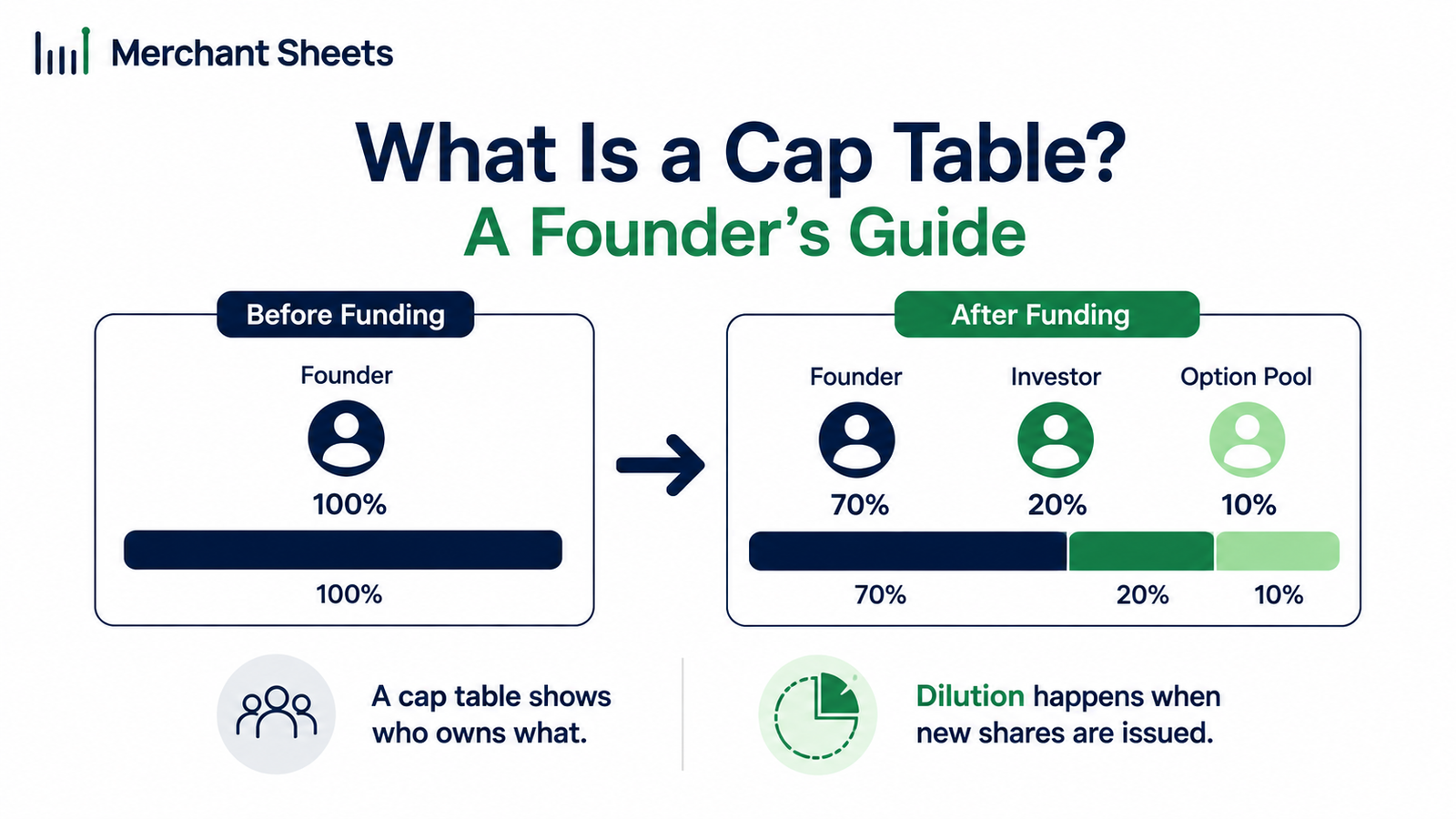
Walk one round with round numbers. A founder owns 1,000,000 shares, 100% of the company. She raises a seed round of $1,000,000 at a $4,000,000 pre-money valuation, so the post-money is $5,000,000, and the investor requires a 10% option pool.
The investor’s $1M buys 20% of the post-money company, the pool takes 10%, and the founder is left with 70%. She still holds all 1,000,000 of her shares; the company simply issued new ones around her.
Table 1. A simple seed-round cap table: $1M raised at a $4M pre-money ($5M post) with a 10% option pool.
| Holder | Shares | Before | After |
|---|---|---|---|
| Founder | 1,000,000 | 100% | 70% |
| Seed investor | 285,714 | – | 20% |
| Option pool | 142,857 | – | 10% |
| Total (fully diluted) | 1,428,571 | 100% | 100% |
| Dilution isn’t losing shares. Your share count can stay the same while your ownership percentage falls, because the company issued new shares around you. |
SAFEs and convertible notes: equity later, not now
Early raises often skip pricing shares and use a SAFE (Simple Agreement for Future Equity) or a convertible note instead. The investor gives cash today for the right to shares later, when you raise a priced round, usually converting at a discount (often around 20%) or a valuation cap that rewards the early risk.
The SAFE, created by Y Combinator, has become the common early instrument.
For the cap table, the key point is that these will become shares, so they belong on the fully diluted view even before they convert, which is exactly why that number matters.
One real difference between the two: a convertible note is debt, so it accrues interest and has a maturity date, while a SAFE is not debt. Both are ways to raise early money without setting a price yet.
How to keep your cap table clean
A cap table is only useful if it’s right, and the cost of a messy one shows up at the worst moment, in the middle of a raise or a sale, when a buyer’s or investor’s lawyer starts checking. A few habits keep it trustworthy:
- Update it the day something changes: Record every share issuance, option grant, SAFE, and transfer as it happens, not months later from memory. The table should always match your signed documents.
- Keep one source of truth: Maintain a single master version rather than emailing copies around, so there’s never a question of which cap table is current.
- Move to software when it gets complex: A spreadsheet is fine early, but once you have several investors, convertibles, and an option pool, dedicated cap table software cuts errors and produces the fully diluted view on demand.
- Model a round before you sign it: Run the dilution math on any new raise or option-pool change first, so you know exactly what your ownership will be on the other side of the deal.
Do ecommerce brands need a cap table?
Most bootstrapped ecommerce brands don’t need a formal cap table, because a single founder or a clean founder split is the entire ownership picture. You need one the moment ownership gains a second layer: you take on an angel or venture investor, bring in a partner for equity, grant employee options, or get ready to sell.
When that day comes, keep the cap table accurate and current from the start, because reconstructing ownership years later is painful and a messy cap table scares off both buyers and investors in diligence.
It’s worth remembering that most ecommerce brands fund growth with debt and inventory financing rather than equity, so many never need more than a simple table (our guide to funding options covers the alternatives). And if a sale is on the horizon, a clean cap table feeds a cleaner process when you sell.
Frequently asked questions
What is a cap table in simple terms?
A cap table is a list of everyone who owns a piece of your company and how much they own, in shares and percentages, including stock, options, and anything that will convert into shares later.
What should a cap table include?
A cap table should include every shareholder with their common or preferred shares, the option pool reserved for employees, and any convertible securities like SAFEs or notes, shown on a fully diluted basis so the percentages reflect all committed equity.
What's the difference between issued and fully diluted shares?
Issued shares are the shares actually granted so far, while fully diluted shares add the option pool and everything that will convert, so fully diluted ownership is the truer picture of who will own what.
How does a funding round affect my cap table?
A priced round issues new shares to investors and often expands the option pool, so existing owners are diluted: your share count can stay the same while your ownership percentage falls as the total share count rises.
Do I need cap table software?
A spreadsheet is fine while your cap table is simple, but once you have several investors, convertible securities, and an option pool, dedicated cap table software cuts errors and keeps the record clean for diligence.
This article is general information, not legal or tax advice. Equity, ownership, and instruments like SAFEs carry legal and tax consequences that vary by situation; work with a qualified professional on your own cap table.
