
Key takeaways
- Hire a fractional CFO when the financial decisions you face outgrow the visibility you have to make them well, which for most ecommerce brands lands somewhere between $1M and $10M in revenue.
- The clearest signals are scaling paid ads without a firm handle on margin, cash staying tight as revenue grows, inventory tying up your cash, adding a sales channel or a big customer, and a coming raise, loan, or sale.
- Revenue is a starting signal, not the rule: a complex multi-channel brand at $2M can need a fractional CFO before a simple single-channel brand at $8M does.
- Below about $1M, most brands get more from hourly advice or a one-time profit and cash audit than from a monthly retainer they can’t yet sustain.
- Messy books alone are a bookkeeper or controller problem, not a reason to hire a CFO; bring in the CFO when you need someone to decide what the numbers mean and what to do next.
- A fractional CFO costs a fraction of a full-time hire, which runs $350,000 or more all-in as of 2026, so the timing question is about need and readiness rather than whether you can afford senior help at all.
You hire a fractional CFO when the decisions in front of you outgrow the financial visibility you have to make them. For most ecommerce brands that happens somewhere between $1M and $10M in revenue, once ad spend, inventory, and cash get too big to run on instinct. Here are the signs it’s time, and the cases where it isn’t.
When should you hire a fractional CFO?
You should hire a fractional CFO, a senior finance leader who works with your business part-time and ongoing, when the financial decisions you face outgrow the visibility you have to make them well. For most ecommerce brands that point lands between $1M and $10M in revenue, triggered by paid-ads scale, inventory tying up cash, or a coming raise.
Timing is a readiness question, not a revenue milestone you cross. It comes down to a handful of clear signals, a revenue range that’s a useful starting point, and a couple of situations where it’s still too early.
Waiting has a cost of its own: the brands that hire too late usually do it after a painful stockout, a channel that lost money for months, or a fundraise that stalled on messy numbers.
If you’re weighing the role itself before the timing, the fractional CFO guide covers what one is, and the walkthrough of what an ecommerce CFO does breaks down the work in detail. This page is about knowing when you’re ready.
The signs it’s time to hire a fractional CFO
A fractional CFO earns its cost once the calls you’re making get bigger than the numbers you can see. These signals tend to travel together, and if two or three of them describe your brand, the case gets hard to ignore. Any one of them is usually enough on its own:
- You’re scaling paid ads without a margin ceiling: Spend is climbing but you don’t have a firm read on contribution margin, what’s left from a sale after the costs that rise with each order, or on your max allowable customer acquisition cost (CAC) by channel. Profitable growth and expensive growth start to look the same.
- Cash feels tight even as revenue grows: The top line is up and the bank balance still keeps you awake, which means you need a rolling cash forecast, a week-by-week view of money in and money out, and nobody is building one.
- Inventory keeps tying up your cash: Reorder timing, order minimums, and financing are guesses, and a stockout or an overstock keeps landing on the bank balance.
- You’re adding a channel or a big customer: Moving into Amazon, wholesale, or retail changes your margins, your payment terms, and your cash cycle, and you want the economics modeled before you commit.
- You’re raising money, borrowing, or planning to sell: A funding round, a line of credit, or an exit is 6 to 12 months out, and your numbers aren’t ready for anyone to look at closely.
- You’re the one building the forecast at 11pm: You’re doing the CFO work yourself in a spreadsheet you rebuild every quarter, and it’s pulling you off the parts of the business only you can run.
What revenue should an ecommerce brand hire a fractional CFO?
There’s no single number, but most ecommerce brands bring in a fractional CFO somewhere between $1M and $10M in revenue, with complexity moving the line as much as size does. A multi-channel, inventory-heavy brand needs one earlier than a simple single-channel business at the same revenue. Below about $1M, hourly help or a one-time audit usually fits better than a retainer.
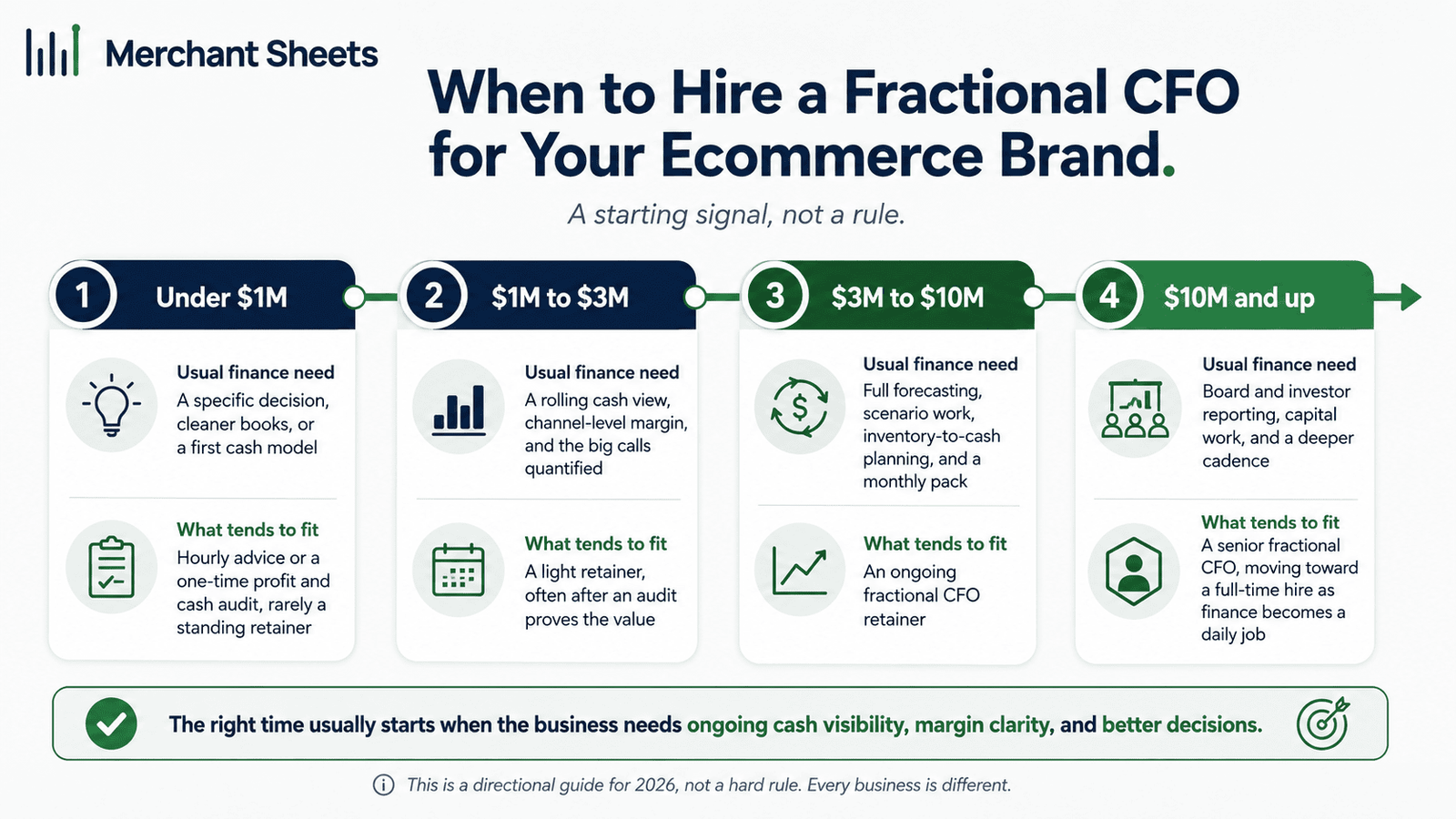
Read the table as a starting map, not a rule. It shows where the conversation usually begins at each stage and what kind of engagement tends to fit, from a one-time diagnostic up to an ongoing retainer. For what each of those costs, see what a fractional CFO costs; here the focus is readiness rather than price.
The reason revenue is a starting point and not the answer is that two brands at the same top line can carry very different complexity, and complexity is what creates CFO-shaped work.
Table 1. When a fractional CFO fits, by ecommerce revenue stage (as of 2026; a starting signal, not a rule).
| Brand revenue | The usual finance need at this stage | What tends to fit |
| Under $1M | A specific decision, cleaner books, or a first cash model | Hourly advice or a one-time profit and cash audit, rarely a standing retainer |
| $1M to $3M | A rolling cash view, channel-level margin, and the big calls quantified | A light retainer, often after an audit proves the value |
| $3M to $10M | Full forecasting, scenario work, inventory-to-cash planning, and a monthly pack | An ongoing fractional CFO retainer |
| $10M and up | Board and investor reporting, capital work, and a deeper cadence | A senior fractional CFO, moving toward a full-time hire as finance becomes a daily job |
Why revenue alone doesn’t tell you
Revenue is a starting signal because the real trigger is the gap between the decisions you face and the visibility you have to make them. A brand doing $2M across Shopify, Amazon, and wholesale, carrying heavy inventory and scaling ads, is making CFO-shaped decisions every week. A simpler $8M brand with one channel and steady margins may not be, yet.
You hire a fractional CFO when the decisions you face outgrow the financial visibility you have to make them, not when you hit a revenue number.
Picture it in real numbers. A brand scaling from $3M to $6M that can’t say which channel makes money after ad spend is making a $6M decision on close to zero visibility, and that’s a fractional CFO problem no matter what the revenue line reads.
The same brand at $6M with clean channel margins, a live cash forecast, and a pricing model already in place may be fine on its own for another year.
So run the test on your own business: line up the calls you’re about to make, on pricing, ad spend, an inventory buy, a new channel, or financing, against whether your current numbers can answer them. When the decisions are bigger than the visibility, it’s time.
A clear read on contribution margin by channel is exactly the kind of visibility a fractional CFO builds, and it’s often the first thing missing when a brand has outgrown its bookkeeper.
When it’s too early to hire a fractional CFO
Not every finance frustration is a CFO problem, and the honest answer builds more trust than a yes you’ll regret. Three situations look like triggers but aren’t, yet:
- Your books are messy or behind: Late reconciliations and statements you can’t trust are a bookkeeper or controller fix first. A CFO decides with clean numbers; they don’t clean them up.
- You’re under about $1M with simple economics: One channel, a handful of SKUs, and steady margins rarely need a standing retainer. Hourly advice or a one-time audit gives you the same senior judgment on the decisions that matter without the fixed cost.
- You want growth but have no decision in front of you: Ambition on its own isn’t a trigger. Wait until there’s a real call to make, a raise, a channel, a big buy, that your numbers can’t answer.
Fractional CFO, controller, or bookkeeper: which do you need?
Placing the three roles keeps you from hiring a CFO to solve a bookkeeping problem, which wastes money on both sides. A bookkeeper records and reconciles your transactions. A controller closes the books and produces statements you can trust.
A fractional CFO decides what those numbers mean and what to do next. If your problem is clean, timely statements, that’s a controller; if it’s what to do with the numbers once you have them, that’s a CFO.
Most growing brands add these roles in order, from recording the numbers to deciding with them, and a fractional CFO sits at the top of that ladder without replacing the people below it.
For the detail on where each role starts and stops, see how the finance roles compare, and for the choice between part-time and a full-time, in-house CFO, that comparison is its own decision.
What to do when you’re on the fence
If you see your brand in a couple of these signals but can’t tell whether it’s time, the lowest-risk way to find out is a fixed-scope profit and cash audit: a one-time diagnostic that surfaces the profit leaks and cash risks in your numbers and hands back a short roadmap.
It answers the timing question on your own business instead of a generic rule, and it doesn’t commit you to anything ongoing.
A good audit usually surfaces a few concrete things: which products or channels lose money once ad spend and fulfillment are counted, where cash gets trapped in the inventory cycle, and which pricing or reorder decisions are quietly costing the most. Those findings are useful whether or not you go further.
Treat the audit as the natural first step rather than a lesser option. It’s a real deliverable with dollar figures attached, and it often becomes the foundation a retainer builds on once the value is clear.
If the audit shows your decisions are big enough to carry a CFO’s fee, you’ll know; if they aren’t yet, you’ll know that too, and you’ll have a cleaner picture of your margins and cash either way.
Frequently asked questions
When should an ecommerce business hire a fractional CFO?
Most ecommerce brands hire a fractional CFO once they cross roughly $1M to $5M in revenue and start making calls on ad spend, inventory, pricing, or a raise that their current numbers can’t answer, which is the point where the decisions outgrow the visibility.
At what revenue should I hire a fractional CFO?
There’s no single number, but the conversation usually starts between $1M and $5M for an ecommerce brand, with complexity mattering as much as size, so a multi-channel, inventory-heavy business often needs one earlier than a simple single-channel brand at the same revenue.
Do I need a fractional CFO or a bookkeeper?
If your problem is that transactions are behind or your statements can’t be trusted, you need a bookkeeper or controller first; a fractional CFO is for deciding what clean numbers mean, on cash, pricing, inventory, and growth, rather than producing them.
Is it too early to hire a fractional CFO?
It’s usually too early if your books are messy or behind, your brand is under about $1M with simple economics, or you have growth ambition but no specific decision your numbers can’t answer, in which case hourly advice or a one-time audit fits better than a retainer.
How do I know if I need a fractional CFO or a full-time one?
Most ecommerce brands under roughly $10M need a fractional CFO, because the work is senior judgment on the big decisions a few days a month; a full-time CFO makes sense once finance is a daily, in-house job, usually past $10M in revenue.
Can a fractional CFO help me get ready to raise or sell?
Yes, getting the numbers investor-ready, building the model, and supporting a fundraise, a loan, or a sale is core fractional CFO work, and a coming transaction is one of the most common reasons ecommerce brands bring one in.
How long before a fractional CFO adds value?
A profit and cash audit or a first cash model usually delivers something useful within the first few weeks, while the compounding value, better inventory, pricing, and spend decisions, builds over the months that follow.
Find out whether it’s time
If you see your brand in a few of these signals but aren’t sure it’s time, you don’t have to sign a retainer to find out.
I work ecommerce numbers as an ecommerce fractional CFO, and I start with a fixed-scope profit and cash audit that shows whether your business holds the kind of decisions a CFO earns their fee on, so you get a straight answer on your own numbers before committing to anything ongoing.
This is general information, not financial advice, and every brand is different. Weigh your own numbers, and check with a professional on your specific situation before you commit.
