
Key takeaways
- Ecommerce bookkeeping typically runs $500 to $5,000 or more a month in 2026, and most $1M to $5M multi-channel brands land between $1,500 and $4,000.
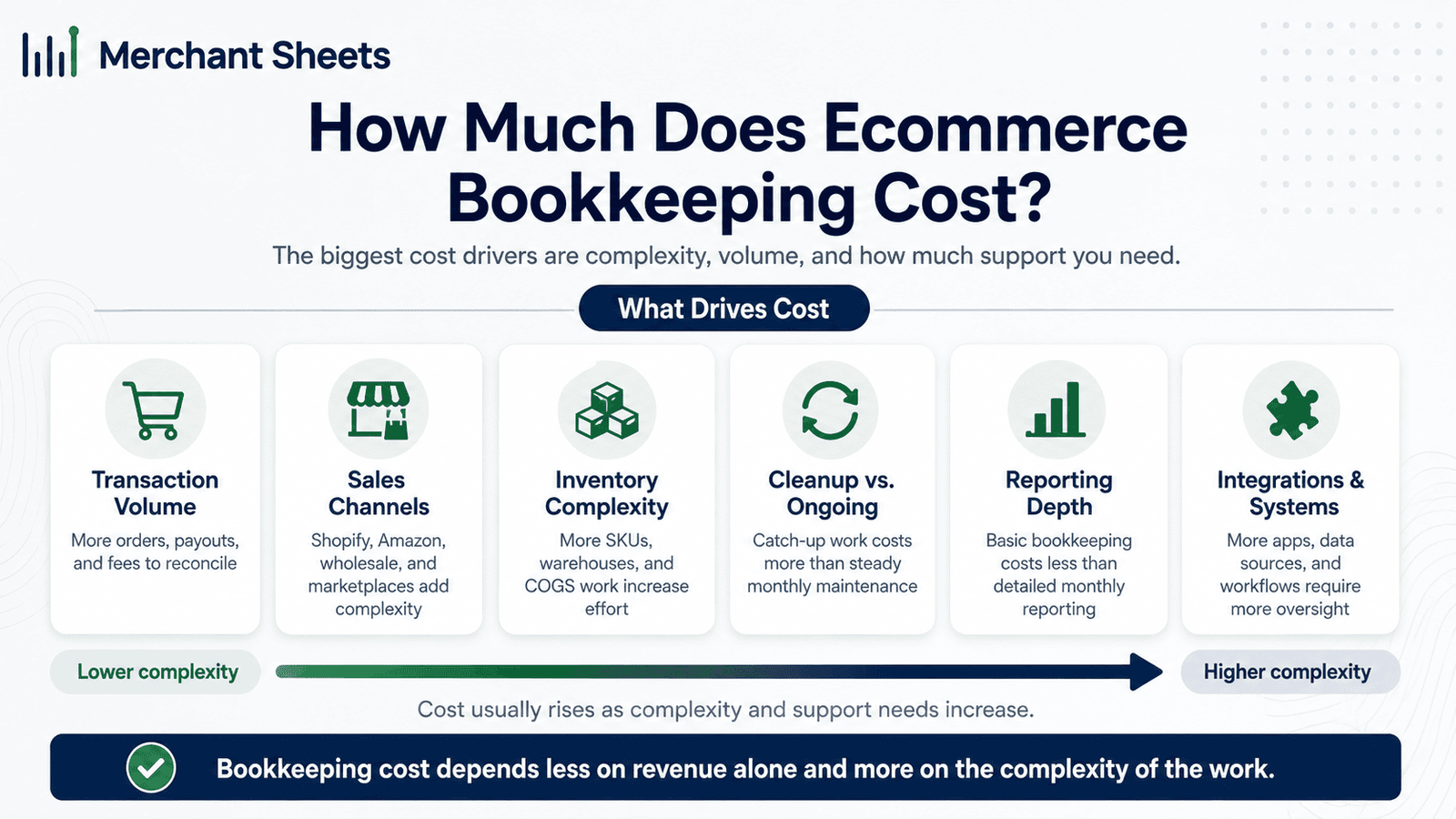
- Cost scales with channel count and complexity rather than revenue, so adding a marketplace raises the price more than adding sales does.
- Specialist ecommerce bookkeeping commonly starts around $750 a month for a single channel and scales from there.
- One-time setup usually starts around $1,500, and cleaning up a backlog is priced by the number of months of catch-up.
- Generic bookkeeping at $200 to $400 a month rarely covers settlement reconciliation, landed-cost COGS, or channel-level profit, which is why ecommerce specialists cost more.
- Doing your own books is free in dollars and costly in time and errors, and most multi-channel brands past roughly $1M move to a service.
Ecommerce bookkeeping costs more than the generic kind, and how much more depends on how you sell. Your channels, transaction volume, and inventory drive the price far more than your revenue does.
Here’s what ecommerce bookkeeping costs in 2026, what moves the number, and how to tell whether you’re overpaying or underserved.
How much does ecommerce bookkeeping cost?
Ecommerce bookkeeping typically costs between $500 and $5,000 a month in 2026. Most single-channel and smaller brands sit under $1,500, while most $1M to $5M multi-channel brands land between $1,500 and $4,000.
Specialist ecommerce bookkeeping commonly starts around $750 a month for a single channel and scales from there.
The range is wide because price tracks how you sell more than what you make. A brand doing $800,000 across three channels can cost more to keep than a brand doing $2M on one, because each channel is its own reconciliation, the routine of tying an account back to an outside record like a payout report.
Treat the ranges below as a way to sanity-check a quote for 2026, and see the complete ecommerce bookkeeping guide for the work behind the price.
Table 1. Typical ecommerce bookkeeping cost by revenue and complexity (2026 ranges, verify).
| Revenue and channels | Typical monthly cost | What it usually covers |
| Under $1M, 1 to 2 channels | $500 to $1,500 | Core reconciliation and monthly close, basic inventory |
| $1M to $5M, Shopify + Amazon | $1,500 to $4,000 | Settlement reconciliation, landed-cost COGS, channel-level P&L |
| $5M to $25M, omni + wholesale | $4,000 to $10,000 | Accrual books, multi-state sales tax, wholesale receivables |
What drives the cost
Channel complexity, rather than revenue, is the real driver of what you’ll pay. Each sales channel adds its own settlement reconciliation, its own fees, and its own quirks, so a brand on Shopify, Amazon, and a wholesale portal carries roughly three times the reconciliation work of a Shopify-only brand at the same revenue.
Reconciling every channel back to its payouts is the bulk of the monthly labor, and it’s covered in reconciling multiple channels.
Volume and account count stack on top. More orders mean more to categorize and match, and every bank, card, and payment processor is another account to reconcile each month. Inventory adds landed-cost COGS, which capitalizes freight and duty into the value of your stock and releases it to cost as units sell.
Each state where you have sales tax nexus, an obligation to collect and remit tax once you cross its threshold, adds tracking too, so a brand collecting in fifteen states costs more to keep than one collecting in two.
The channel effect is large enough to price around. As a rough 2026 guide, each additional marketplace adds something like 20 to 30 percent to the monthly cost, and a Shopify-plus-Amazon brand often runs 40 to 60 percent more than a Shopify-only brand at the same revenue.
Full omni-channel with wholesale can run over double. The main levers are below.
Table 2. What drives your ecommerce bookkeeping cost.
| Cost driver | Why it raises the price |
| Number of sales channels | Each marketplace adds its own reconciliation and fees; the single biggest driver |
| Transaction volume | More orders mean more to categorize, match, and reconcile every month |
| Bank and processor accounts | Every bank, card, and processor is another account to reconcile |
| Inventory and landed-cost COGS | Capitalizing freight and duty and tracking inventory adds monthly work |
| Sales tax states (nexus) | Each state where you have nexus adds tracking and, where filed, compliance |
| Accrual and channel-level P&L | Accrual books and per-channel profit take more work than cash-basis bookkeeping |
| Catch-up or cleanup backlog | Books that are behind carry a one-time fee to bring them current |
Why ecommerce bookkeeping costs more than generic bookkeeping
Generic bookkeeping priced at $200 to $400 a month is built for a service business with a bank feed and a few dozen transactions. It categorizes what comes through the bank and reconciles to the statement, and for a consultant or an agency that’s enough. An ecommerce brand needs more: settlement reconciliation that ties each channel’s payouts back to gross sales, fees, and refunds, plus landed-cost COGS, inventory, and multi-state sales tax.
Reconciling a single Amazon settlement can take a few hours once you split it into sales, referral and fulfillment fees, and refunds, and that repeats every payout period on every channel. It’s more work, and it needs someone who knows the platforms.
So the higher price buys labor and expertise, rather than a premium for its own sake. A quote well below the ranges above usually means the reconciliation and COGS work isn’t part of it, which tends to surface later as books that don’t tie to the bank or a gross margin that looks healthier than it is.
One-time costs: setup and cleanup
Two one-time costs sit alongside the monthly fee. Setup and migration, which means building the ecommerce chart of accounts, configuring QuickBooks or Xero, connecting your channels through a connector, and moving over history, commonly starts around $1,500 and rises with channel count and how much history comes across. It’s the technical on-ramp that makes the monthly work clean from day one.
Cleanup, or catch-up, brings behind or messy books current, and it’s usually priced by the number of months of backlog, so a brand six months behind pays more than one two months behind.
A fundraise, a tax deadline, or a departing bookkeeper is the usual trigger. Both are one-time projects that lead into the ongoing monthly fee in the tables above.
DIY, software, or a bookkeeper: the real cost
Most brands weigh three ways to get the books done. Doing it yourself costs little in dollars and a lot in hours, and it holds up at low volume on a single channel; the signs it has stopped working are in outgrown your spreadsheets.
Accounting software like QuickBooks or Xero paired with a connector runs a modest monthly software fee and still needs someone who understands settlement reconciliation and COGS. A professional bookkeeper or service is the done-for-you option most multi-channel brands move to as they grow, priced in the ranges above.
Which one is cheaper depends on the value of your time and how complex your books are. A few hours a week on reconciliation is cheap at $500,000 on one channel and expensive at $3M across four, where those hours are worth more spent on the business and the error risk climbs.
The full in-house-versus-outsourced comparison is weighed in outsourced vs in-house bookkeeping, and the table below lays out the real cost of each path.
Table 3. DIY, software, or a service: the real cost.
| Option | Typical cost | The trade-off |
| DIY in a spreadsheet | Your time | Free in dollars; expensive in hours and errors as channels and inventory grow |
| Accounting software plus a connector | Roughly $30 to $200+ a month in software | Handles the volume, but you still do the work and need to know reconciliation and COGS |
| A professional bookkeeper or service | Roughly $750 to $5,000+ a month | Done for you by a specialist; the cost scales with channel count and complexity |
Frequently asked questions
How much does ecommerce bookkeeping cost per month?
Ecommerce bookkeeping usually costs $500 to $5,000 or more a month in 2026, with single-channel brands often under $1,500 and $1M to $5M multi-channel brands between $1,500 and $4,000, because the price scales with channel complexity.
Why is ecommerce bookkeeping more expensive than regular bookkeeping?
Ecommerce bookkeeping costs more because it adds settlement reconciliation across channels, landed-cost COGS, inventory, and multi-state sales tax on top of standard bookkeeping, which is more work and needs someone who knows the platforms.
What makes bookkeeping cost go up?
The main drivers are the number of sales channels, transaction volume, the count of bank and processor accounts, inventory and landed-cost COGS, the number of sales tax states, and whether the books are on accrual with channel-level profit.
How much does it cost to set up ecommerce bookkeeping?
One-time setup and migration commonly starts around $1,500 and rises with channel count and how much history is moved, while cleaning up a backlog is usually priced by the number of months the books are behind.
Is it cheaper to do my own ecommerce bookkeeping?
Doing your own books costs little in software and a lot in time and risk, and it works at low volume on one channel, though most multi-channel brands past roughly $1M find a service cheaper once the hours and errors are counted.
How do I know if a bookkeeping quote is fair?
Compare the quote to your complexity: a price well below the market ranges for your channel count usually means settlement reconciliation and COGS aren’t included, which shows up later as books that don’t tie.
Does bookkeeping cost scale with revenue or with channels?
Bookkeeping cost scales mostly with channel count and complexity, so a lower-revenue brand selling on three channels can cost more to keep than a higher-revenue brand on a single channel.
