
Key takeaways
- Every business has three core financial statements: the profit and loss statement (P&L) shows whether you made money over a period, the balance sheet shows what you own and owe at a point in time, and the cash flow statement shows where the cash went.
- The three answer different questions, so they’re read together: the P&L answers whether you profited, the balance sheet answers what the business owns and owes, and the cash flow statement answers why the bank balance is what it is.
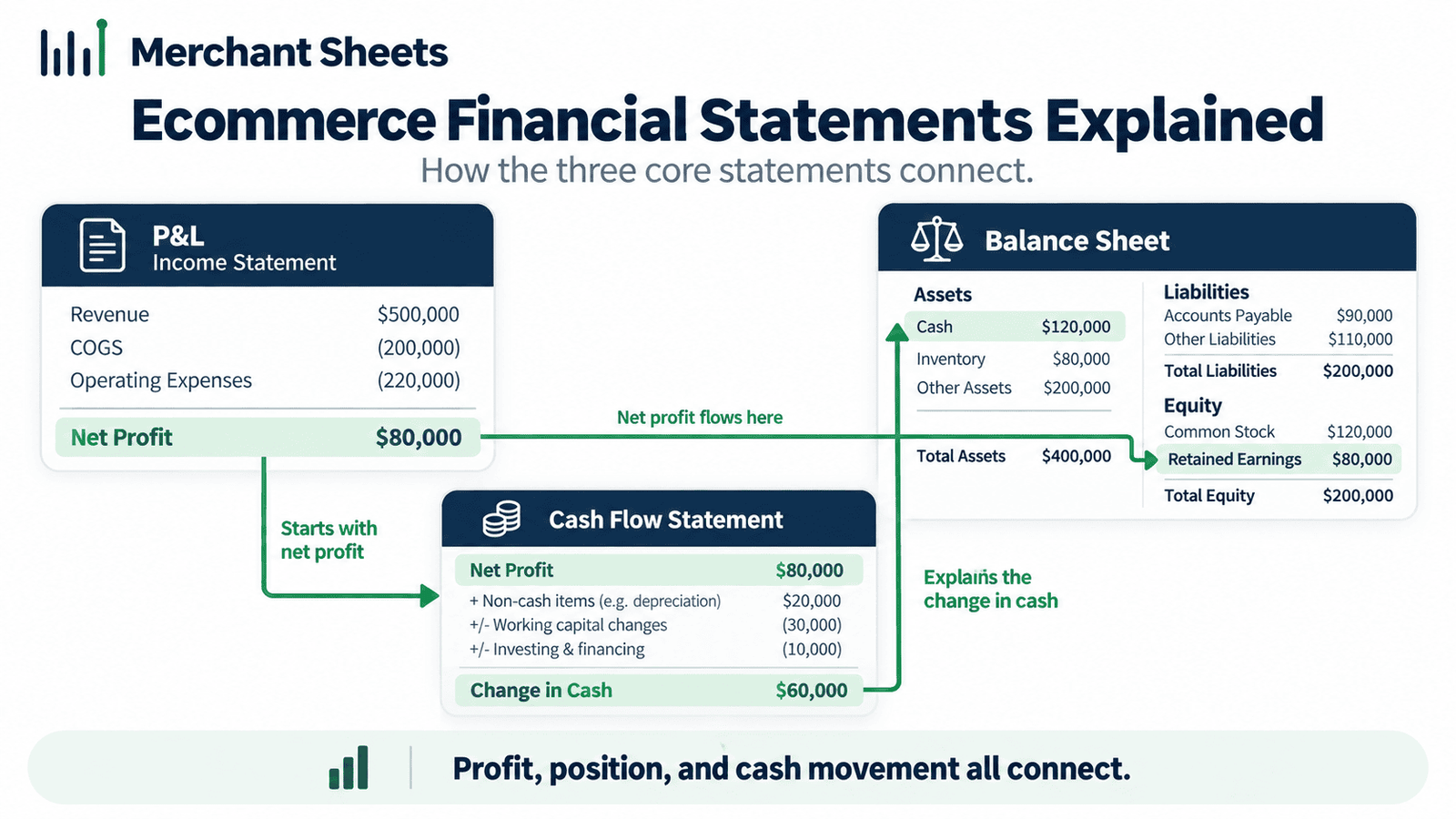
- The statements tie to each other: your P&L’s net profit flows into the balance sheet as retained earnings, and the cash flow statement starts from that same profit and reconciles it to the actual change in your cash.
- An ecommerce business can be profitable and still run short on cash, because inventory you’ve bought but not sold ties up cash the P&L never shows, and marketplaces hold a reserve and pay out on a lag.
- Each statement carries ecommerce lines a generic template skips: inventory and marketplace reserves on the balance sheet, contra-revenue and the fee stack on the P&L, and big inventory buys on the cash flow statement.
- The statements are only as accurate as the books behind them, so if inventory, reserves, and contra-revenue are recorded wrong, all three read wrong at once.
Your bookkeeper sends three financial statements every month, and some founders only read one of them. The profit and loss statement is a third of the picture, and on its own it can tell you that you made money in a month your bank balance shrank. Here’s what all three ecommerce financial statements are, and how they fit together.
What are the three financial statements?
Every business has three core financial statements. The profit and loss statement (P&L), also called the income statement, shows what you earned and spent over a period and the profit left. The balance sheet shows what you own and owe at a single point in time.
The cash flow statement shows how much cash moved, and where. Together they’re the financial picture of the business.
Each one answers a different question, and reading only the P&L leaves two of them unanswered, because profit isn’t the same as cash and neither figure tells you what the business owns or owes.
Table 1. The three ecommerce financial statements at a glance.
| Statement | The question it answers | Covers | Ecommerce lines that matter most |
| Profit & loss (income statement) | Did we make money over the period? | A period (a month, a quarter, a year) | Contra-revenue, the marketplace fee stack, contribution margin, ad spend |
| Balance sheet | What do we own and owe right now? | A single point in time | Inventory, marketplace reserve and pending balances, sales tax payable, owner equity |
| Cash flow statement | Where did the cash go? | A period, reconciling to the cash change | Inventory purchases, the payout lag and reserve, the gap between profit and cash |
The profit and loss statement: Did you make money?
The profit and loss statement shows what your business earned and spent over a period and what was left as profit, read top to bottom from revenue down to net profit.
For an ecommerce business it reads in margin layers, gross, then contribution, then operating, so you can see the product’s margin, the sale’s margin after fees and fulfillment, and the business’s margin after fixed costs.
A few ecommerce moves make this statement read true. Revenue starts at net revenue, the figure left after discounts, refunds, and returns come off the top as contra-revenue, an amount that reduces sales rather than a cost you spend.
Then the costs. Variable per-order fees like referral, fulfillment, and payment processing sit in cost of goods sold (COGS), the direct cost of the goods you sold, while the fixed platform plan is an operating expense.
Advertising is the swing line that can sit in either place depending on how you read the sale.
That’s the overview. The full read, the four margin layers, the lines that trip founders up, and a worked ecommerce P&L you can hold your own numbers against, is covered in how to read your ecommerce P&L.
What the P&L can’t tell you is what you own, what you owe, or how much cash you hold, which is where the next two statements come in.
The balance sheet: What you own and what you owe
The balance sheet is a snapshot at a single moment of what the business owns, called assets, what it owes, called liabilities, and what’s left for the owner, called equity. It always balances, because assets equal liabilities plus equity, an identity known as the accounting equation.
Where the P&L covers a stretch of time, the balance sheet is a photograph of one day.
For most ecommerce brands, inventory is the largest asset on the balance sheet, cash sitting on a shelf as unsold product, which is one reason a profitable brand can still be short on cash.
A few other ecommerce lines sit nearby. A marketplace reserve or pending balance is money a platform like Amazon has earned you but is still holding. Sales tax payable is tax you collected and owe, so it’s a liability rather than your money. Gift card liability is cash taken for cards not yet redeemed.
On the equity side, retained earnings is the running total of every period’s profit kept in the business, and it’s the line the P&L feeds into. Where each of these accounts lives is set by the chart of accounts.
| The P&L tells you whether the month was profitable. The balance sheet tells you what that profit turned into, often inventory on a shelf and cash a marketplace is holding, which is why profit on paper and cash in the bank are rarely the same number. |
The cash flow statement: where the cash went
The cash flow statement shows how much cash moved over a period and where it came from and went, sorted into three buckets: operating activities, the cash from running the business, investing activities, the cash for long-term assets, and financing activities, the cash from loans and owners.
It’s the statement that explains why your bank balance changed, and it’s the one most founders never open.
Here’s what makes it different. The P&L runs on an accrual basis, recording a sale when it’s earned and a cost when it’s incurred rather than when cash changes hands, so it can show a profit while cash falls.
The cash flow statement corrects for that, starting from net profit and adjusting for the things that moved cash but not profit, and the reverse.
For ecommerce the big adjustments are inventory, since a large purchase order is cash out that never touches the P&L until the product sells, the marketplace payout lag and reserve, and non-cash costs like depreciation. Here’s the shape of the statement.
Table 2. The three sections of an ecommerce cash flow statement.
| Section | What it captures | Common ecommerce items |
| Operating activities | Cash from running the business day to day | Net profit, then changes in inventory, payables, and the marketplace reserve; depreciation added back |
| Investing activities | Cash for long-term assets | Equipment, a warehouse buildout, capitalized software; usually small for a lean brand |
| Financing activities | Cash from funders and owners | A loan or line of credit drawn or repaid, owner contributions, and owner draws or distributions |
How the three statements connect
The three statements are one linked system, and the links are specific. Your P&L’s net profit flows into the balance sheet as retained earnings, raising the owner’s equity.
The cash flow statement starts from that same net profit and adjusts it to the actual change in cash, and that change ties to the cash line on the balance sheet. Because of those links, the balance sheet balances only when the other two are right.
Walk one month to see it. The figures below are illustrative teaching numbers. The month earns a net profit of $16,000 on the P&L, and that $16,000 lands on the balance sheet as an increase in retained earnings, so the business is worth more on paper.
The cash flow statement starts from the same $16,000 and tells a different part of the story. The brand bought $30,000 of inventory for the season, which is cash out but not a P&L cost yet, because the product hasn’t sold. A marketplace increased its held reserve, and only part of that was offset by paying suppliers on terms.
Cash from operations came out negative, and the bank balance fell by about $10,000. Profit up $16,000, cash down $10,100, in the same month, and both statements are correct.
Table 3. One month, three statements: how a profitable month can still drain cash (illustrative numbers).
| Line | Where it shows | Amount |
| Net profit for the month | P&L (bottom line) | $16,000 |
| Increase in retained earnings | Balance sheet (equity) | +$16,000 |
| Start from net profit | Cash flow (operating) | $16,000 |
| Add back depreciation (non-cash) | Cash flow (operating) | +$1,900 |
| Less: inventory purchased for the season | Cash flow (operating) | ($30,000) |
| Add: bought inventory on supplier terms (payables up) | Cash flow (operating) | +$8,000 |
| Less: cash held in the marketplace reserve | Cash flow (operating) | ($6,000) |
| Cash from operations | Cash flow (subtotal) | ($10,100) |
| Change in the bank balance | Balance sheet (cash) | ($10,100) |
Why your ecommerce business is profitable but out of cash
The most common reason a profitable ecommerce brand runs short on cash is inventory, the cash you spent on product that’s sitting unsold, which the P&L treats as an asset and not a cost until it sells.
Add the marketplace payout lag and reserve, plus the timing gap built into accrual accounting, and a healthy P&L can sit on top of a shrinking bank account. This is the gap the cash flow statement exists to explain.
Take the three in turn. Inventory ties up cash before it becomes profit or loss: a big purchase order leaves the bank this month and only reaches the P&L as cost of goods sold when each unit sells.
That’s why a growing brand that stocks up can feel poor while looking profitable, and why inventory is often the biggest cash drain a brand has.
Marketplace timing holds cash you’ve earned, because platforms pay on a schedule and hold a reserve, so revenue on the P&L can be cash you can’t touch for weeks.
Accrual timing spreads the gap, since the P&L books revenue and costs when they’re earned or incurred rather than when cash moves, so profit and cash diverge month to month, a difference covered in cash vs accrual accounting.
The forward-looking way to see the squeeze before it hits is a cash flow forecast, and the working-capital view of the same problem is net working capital.
| Profit is an opinion about a period; cash is a fact about a moment. An ecommerce brand can be profitable and out of cash at the same time, usually because the profit is sitting on a shelf as inventory or inside a marketplace reserve. |
How do you read all three statements together each month?
Once your books are closed for the month, you can read all three statements together in about ten minutes by going in a fixed order, P&L first, then cash flow, then balance sheet, and reading them as one system.
If you sell on more than one channel, the same read applies to each, which is the work of multi-channel ecommerce accounting. Work through these steps.
- Start with the P&L and confirm the month was profitable, reading it in margin layers rather than line by line.
- Move to the cash flow statement and find whether cash rose or fell, and which line drove it, usually inventory, the reserve, or a loan.
- Reconcile the two in your head: if profit was up but cash was down, name the reason on the cash flow statement so a tight month is explained rather than a surprise.
- Open the balance sheet and check the big ecommerce lines: inventory, which rising fast can mean cash getting tight, the marketplace reserve, and the sales tax you’ve set aside.
- Confirm the statements tie: net profit should match the rise in retained earnings, and the cash flow’s ending change should match the move in the balance sheet’s cash line.
- If anything doesn’t tie, treat it as a bookkeeping problem to fix, since all three statements are only as good as the books behind them.
Frequently asked questions
What are the three main financial statements?
The three are the profit and loss statement, also called the income statement, which shows profit over a period; the balance sheet, which shows what you own and owe at a point in time; and the cash flow statement, which shows where the cash moved.
What's the difference between the P&L and the balance sheet?
The P&L covers a period of time and shows whether you made a profit, while the balance sheet is a snapshot at a single moment showing what the business owns and owes, so one is a stretch of time and the other is a photograph of one day.
How are the three financial statements connected?
Net profit on the P&L flows into the balance sheet as retained earnings, and the cash flow statement starts from that same profit and reconciles it to the change in cash, which ties to the balance sheet’s cash line, so the three link into one system.
Why is my ecommerce business profitable but has no cash?
Usually your cash is tied up in inventory you’ve bought but not sold, which the P&L treats as an asset rather than a cost, and marketplaces hold a reserve and pay out on a lag, so profit on paper and cash in the bank differ.
Which financial statement matters most for ecommerce?
No single one, because the P&L tells you if you’re profitable, the cash flow statement tells you if you can pay your bills, and the balance sheet tells you what you own and owe, and an ecommerce brand needs all three since it can be profitable and out of cash at once.
Does inventory show up on the income statement?
Not when you buy it, because inventory is an asset on the balance sheet, and it only reaches the income statement as cost of goods sold when the product sells, which is why a big purchase order doesn’t reduce this month’s profit.
How often should I review my financial statements?
Monthly, once the books are closed, reading all three together, since a quarterly-only review is too slow to catch a margin slipping or cash tightening before it becomes a problem.
Where do I find my financial statements?
In your accounting software, since QuickBooks and Xero both produce a profit and loss report, a balance sheet, and a statement of cash flows, though for an ecommerce business they’re only accurate if inventory, marketplace payouts, and contra-revenue are recorded correctly first.
Get financial statements that tie to your bank account
Your three statements only tell you the truth when the books behind them are right, and ecommerce is where they quietly go wrong, inventory booked as a cost too early, a marketplace reserve nobody tracks, sales tax counted as revenue.
Getting the books to produce a P&L, balance sheet, and cash flow statement that agree with each other, and that read by channel, is the accounting work I do for ecommerce brands, inside QuickBooks or Xero.
If your statements never seem to match what’s in the bank, tell me how you sell and I’ll show you where they’re breaking.
This is general education, not financial or tax advice. How each line should be recorded, and how it nets across your own statements, depends on your setup, so confirm the specifics with a qualified accountant before you rely on them.
