
Key takeaways
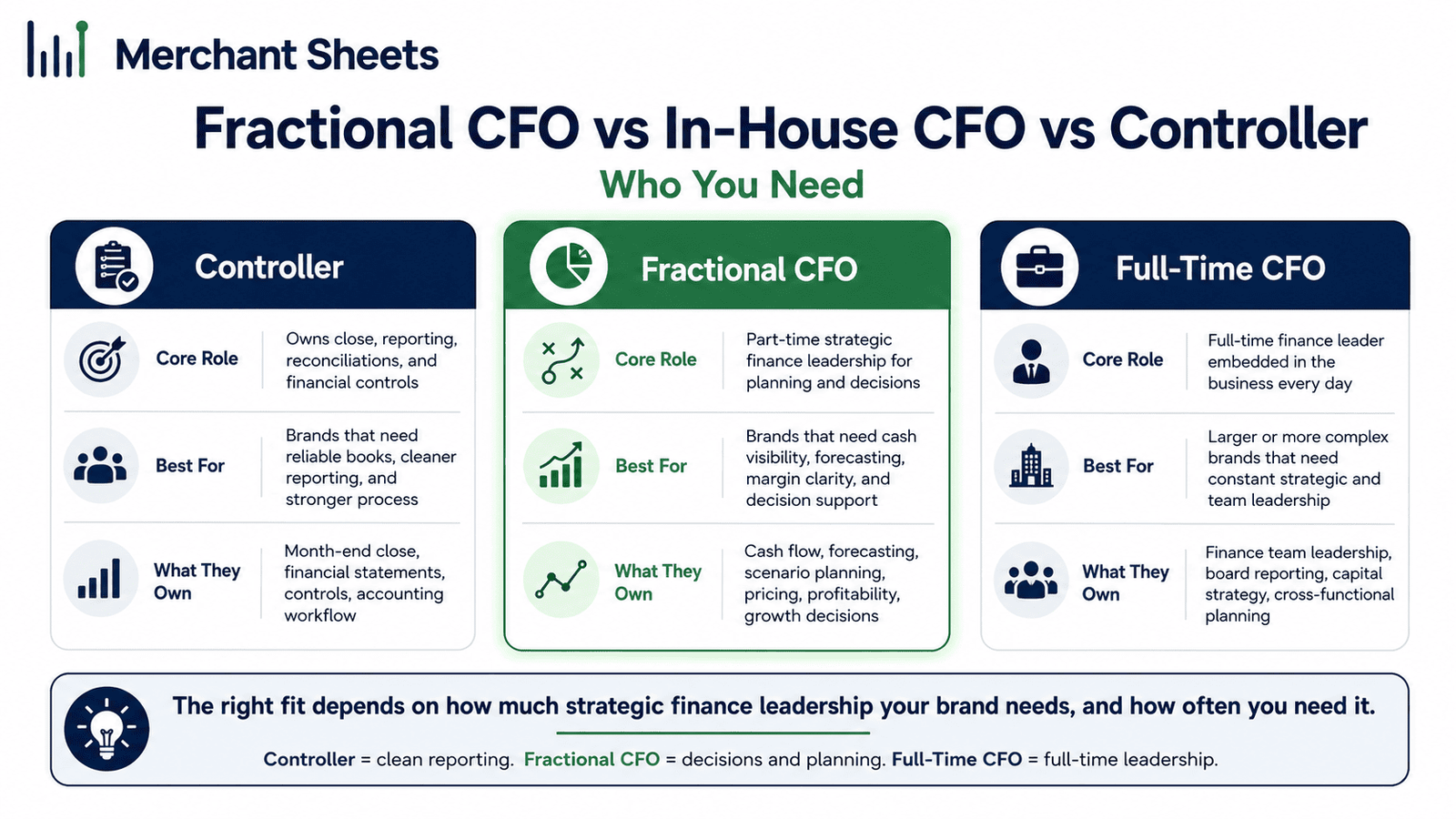
- A controller owns accurate, timely books and the monthly close; a fractional CFO owns the strategy behind the numbers part-time; a full-time in-house CFO does the strategic work full-time, in-house, at scale.
- The quick rule: a controller looks backward and makes the numbers right, a CFO looks forward and decides what to do with them.
- For an ecommerce brand between $500K and $10M, a fractional CFO covers almost the entire range; a full-time in-house CFO usually waits until roughly $10M or more, when finance is a daily job.
- Many brands need a controller before or alongside a CFO, because a fractional CFO decides with clean numbers rather than producing them.
- A full-time in-house CFO costs $350,000 or more all-in as of 2026, while a fractional CFO delivers the same senior judgment for a fraction of that.
- The roles stack rather than compete: a bookkeeper and controller produce clean numbers, and a fractional or full-time CFO decides with them.
A controller keeps your books accurate and on time. A fractional CFO uses those numbers to steer cash, margin, and growth part-time. A full-time in-house CFO does that strategic work full-time, at scale. For most ecommerce brands the real question is which one you need first, and when. Here’s how to choose.
Fractional CFO vs in-house CFO vs controller: what’s the difference?
A controller owns accurate, timely books and the monthly close, looking backward at what happened. A fractional CFO, a senior finance leader who works with your business part-time and ongoing, owns strategy, cash, margin, and forecasting, looking forward at what to do next. A full-time in-house CFO does that same strategic work full-time and in-house at scale.
The three roles sit at different points between recording the numbers and deciding with them, and they cost very differently. The right one depends on your size and on what’s breaking: the books, or the decisions made from them.
Table 1. Controller vs fractional CFO vs full-time in-house CFO, at a glance (as of 2026).
| Controller | Fractional CFO | Full-time in-house CFO | |
| Focus | Accurate, timely books and the monthly close | Strategy: cash, margin, forecasting, fundraising | The same strategy, full-time and in-house |
| Time horizon | Backward-looking (what happened) | Forward-looking (what to do next) | Forward-looking, day to day |
| Commitment | Ongoing, in-house or outsourced | Part-time, a few days a month | Full-time employee |
| Typical cost (2026) | $70,000 to $150,000+ a year in-house | $3,000 to $12,000+ a month | $350,000+ all-in per year |
| Best for | Clean multi-channel books and reporting | Senior decisions without a full-time hire | Finance as a daily job, roughly $10M or more |
What a controller does for an ecommerce brand
A controller is the role that makes the numbers right and keeps them on time. They own the monthly close, accurate financial statements, reconciliations across every channel, and the accounting systems that feed them.
For an ecommerce brand that means a clean multi-channel close across Shopify and Amazon, correct inventory and cost of goods sold (COGS) accounting, and reporting an owner or a CFO can trust. A controller sits above the bookkeeper and can be a full-time hire or an outsourced service.
On an ecommerce brand, that work is heavier than it sounds. A controller reconciles Amazon settlements against deposits, ties A2X or the sales-channel feed back to the books, keeps inventory and COGS accurate as products move between warehouses, and makes sure sales tax is recorded correctly across states. The output is a close that ties out and statements that hold up when a lender, a buyer, or a CFO looks closely.
Where the controller stops is the strategy. They produce reliable numbers, but deciding what to do with them, how to price, when to buy inventory, where to put the next dollar of ad spend, is the CFO’s job.
A brand typically needs a controller once transaction volume and channels have outgrown a bookkeeper and the monthly close starts running slow or shaky. For the roles beneath the controller, the bookkeeper and accountant comparison breaks down who does what.
What a fractional CFO does for an ecommerce brand
A fractional CFO is the strategic layer that sits on top of clean books. The work is cash forecasting, unit economics and margin by channel and stock keeping unit (SKU), inventory-to-cash decisions, pricing, scenario planning, and support for a fundraise or a lender, delivered a few days a month by a senior person. It’s the same seniority a full-time CFO brings, without the full-time seat or the full-time cost.
A concrete example makes the difference clear. Faced with a plan to double ad spend, a controller can tell you what you spent last month; a fractional CFO tells you the max you can spend to acquire a customer and still clear margin, then models what the buy does to cash over the next quarter.
Because the role is about decisions, the numbers it turns on are specific: a clear read on contribution margin by channel usually matters more to a fractional CFO than any single line on the income statement. This article keeps to the comparison, so for the full role, the deep dive on what an ecommerce CFO does walks through a fractional CFO’s week in detail.
What a full-time in-house CFO does, and when you need one
A full-time in-house CFO does everything a fractional CFO does, but as a permanent, in-house executive who also builds and runs the finance team. The trigger is scale.
Once finance is a daily, full-time job, usually past roughly $10M in revenue, or once a board, active fundraising, or an acquisition demands a dedicated internal leader, a full-time seat earns its keep. Below that, the seat sits underused while the bill runs.
The cost is the other half of the decision. As of 2026, a full-time ecommerce CFO runs $350,000 or more all-in once salary, bonus, benefits, and recruiting are counted, and the first-year cost climbs higher with a search fee.
A brand that needs full-time senior help for only a few months, to cover a gap or steer a transition, is usually looking for an interim CFO rather than a permanent hire. For how the part-time fee compares in detail, see what a fractional CFO costs.
Fractional CFO vs full-time in-house CFO: which should you hire?
For almost every ecommerce brand under roughly $10M, a fractional CFO is the right call. The need at that stage is senior judgment on the big decisions a few days a month, the kind of help a part-time engagement is built for.
A full-time in-house CFO makes sense past about $10M, or earlier when a board, a raise, or an acquisition requires a dedicated internal leader and finance has become a daily job.
Read the table as a starting map rather than a rule, because complexity can pull the line either way. A brand with several channels, multiple entities, or live deal activity may need a full-time leader sooner than its revenue suggests, while a simple single-channel business can stay fractional well past the usual mark.
If you’re still weighing the role itself, the fractional CFO guide covers what one is and does.
Table 2. Fractional or full-time in-house CFO, by ecommerce revenue stage (as of 2026; a starting point to adjust for your own complexity).
| Brand revenue | The usual right call | Why |
| Under $5M | A fractional CFO | Senior judgment on the big calls a few days a month; a full-time seat would sit underused |
| $5M to $10M | A fractional CFO, sometimes a blended team | The sweet spot for fractional; add controller-level support beneath the CFO as volume grows |
| $10M to $25M | Evaluate: fractional or a first full-time hire | Depends on transaction volume, channels, entities, and whether finance is now a daily job |
| $25M and up | A full-time in-house CFO, often with a team | Finance is a full-time function, and a board or deal activity usually needs a dedicated leader |
Do you need a controller or a CFO?
This is the most common real mix-up, and hiring the wrong one wastes money on both sides. The test is simple. If your books are late, wrong, or hard to trust, you need a controller, or a bookkeeper first. If your books are clean but nobody is deciding what they mean for cash, pricing, inventory, and growth, you need a CFO.
Plenty of brands discover they need the controller first, because a CFO decides with clean numbers rather than producing them.
It’s often not a choice between the two. A growing brand may need both: a controller to run the close and keep the numbers trustworthy, and a fractional CFO to steer the decisions on top of them, added in sequence as the business grows.
A common path looks like this: a $3M brand hires an outsourced controller to fix a close that’s three weeks late, then brings in a fractional CFO six months later to turn those now-reliable numbers into a cash plan and a pricing decision.
For the signals that say you’re ready for the CFO layer, when to hire a fractional CFO walks through the timing.
How the three roles work together
The clearest way to hold all three is as a stack rather than a set of rivals. A bookkeeper records the transactions, a controller closes the books and produces statements you can trust, and a CFO, fractional or full-time, decides what those numbers mean and what to do next.
Each role sits on top of the one before it, and most ecommerce brands add them in that order as they grow.
In practice, a fractional CFO usually works on top of your existing bookkeeper or controller rather than replacing them, which is part of what keeps the model affordable.
If your books are already clean and the gap is decision-making, the missing layer is the CFO. If the books themselves are the problem, the missing layer is the controller. Getting that order right saves you from paying CFO rates to fix a bookkeeping issue.
Frequently asked questions
What's the difference between a fractional CFO and a controller?
A controller owns accurate, timely books and the monthly close, looking backward at what happened, while a fractional CFO uses those numbers to make forward-looking decisions on cash, margin, pricing, and growth, so the CFO sits a level above the controller in what they decide.
Do I need a controller or a CFO?
If your books are late, wrong, or hard to trust, you need a controller or a bookkeeper first; if your books are clean but no one is deciding what they mean for cash, pricing, and growth, you need a CFO, and many growing brands end up needing both in sequence.
Is a fractional CFO better than a full-time CFO?
For most ecommerce brands under roughly $10M a fractional CFO is the better fit, because it delivers senior judgment on the big decisions a few days a month without the $350,000-plus all-in cost of a full-time hire that would sit underused.
At what revenue should I hire a full-time CFO instead of a fractional one?
A full-time in-house CFO usually makes sense past roughly $10M to $25M in revenue, or earlier when a board, active fundraising, or an acquisition requires a dedicated internal leader and finance has become a daily, full-time job.
What's the difference between a fractional CFO and an in-house CFO?
They do the same strategic work; a fractional CFO does it part-time across a few businesses for a monthly fee, while an in-house CFO is a full-time employee who also builds and runs the finance team, at several times the cost.
Can a fractional CFO do a controller's job?
A fractional CFO can set up and oversee the close and reporting, but ongoing controller work, the monthly close, reconciliations, and clean statements, is usually cheaper and better handled by a controller or bookkeeper, with the CFO deciding with the numbers rather than producing them.
Does an ecommerce brand need a controller?
Once transaction volume and channels outgrow a bookkeeper and the monthly close gets slow or unreliable, an ecommerce brand needs a controller, in-house or outsourced, to keep the multi-channel books accurate before a CFO can make good decisions on top of them.
