
Key takeaways
- An ecommerce CFO is the senior finance leader who turns your books into decisions: they own cash flow, profitability by channel and SKU, forecasting, and the reporting behind every big move.
- What sets an ecommerce CFO apart from a generalist is the ecommerce economics: contribution margin by channel, inventory-to-cash timing, Amazon and Shopify fee mechanics, and ad-spend efficiency.
- An ecommerce CFO sits above your bookkeeper and controller. They don’t record transactions or run the monthly close; they decide what the numbers mean and what to do next.
- Most brands under roughly $10M get this as a fractional or remote CFO, part-time and ongoing, rather than a full-time hire that costs $350,000 or more all-in as of 2026.
- The clearest sign you need one: you’re making six-figure decisions on inventory, ad spend, and pricing, and your bookkeeper is being asked questions above their role.
An ecommerce CFO takes the numbers your bookkeeper records and turns them into a plan: how much cash you’ll have in 13 weeks, which channels and SKUs make money, and what to do about it. Here’s exactly what the role covers for a DTC or Amazon brand, and how to tell whether you need one.
What is an ecommerce CFO?
An ecommerce CFO is a senior finance leader who owns the financial strategy of an online business: the cash, the profitability, the forecasting, and the reporting behind its growth. The ecommerce part matters, because the role is built around channel-level margin, inventory as cash, and the fee mechanics of selling DTC and on Amazon.
Put plainly, a CFO decides with the numbers, while your bookkeeper and accountant produce them. Most brands under roughly $10M don’t put a full-time chief financial officer (CFO) on payroll for this. They get the same senior judgment part-time from a fractional CFO, a senior finance leader who works with your business on an ongoing basis without joining the team full-time.
Our fractional CFO guide covers how that model works; here we’re focused on the job itself.
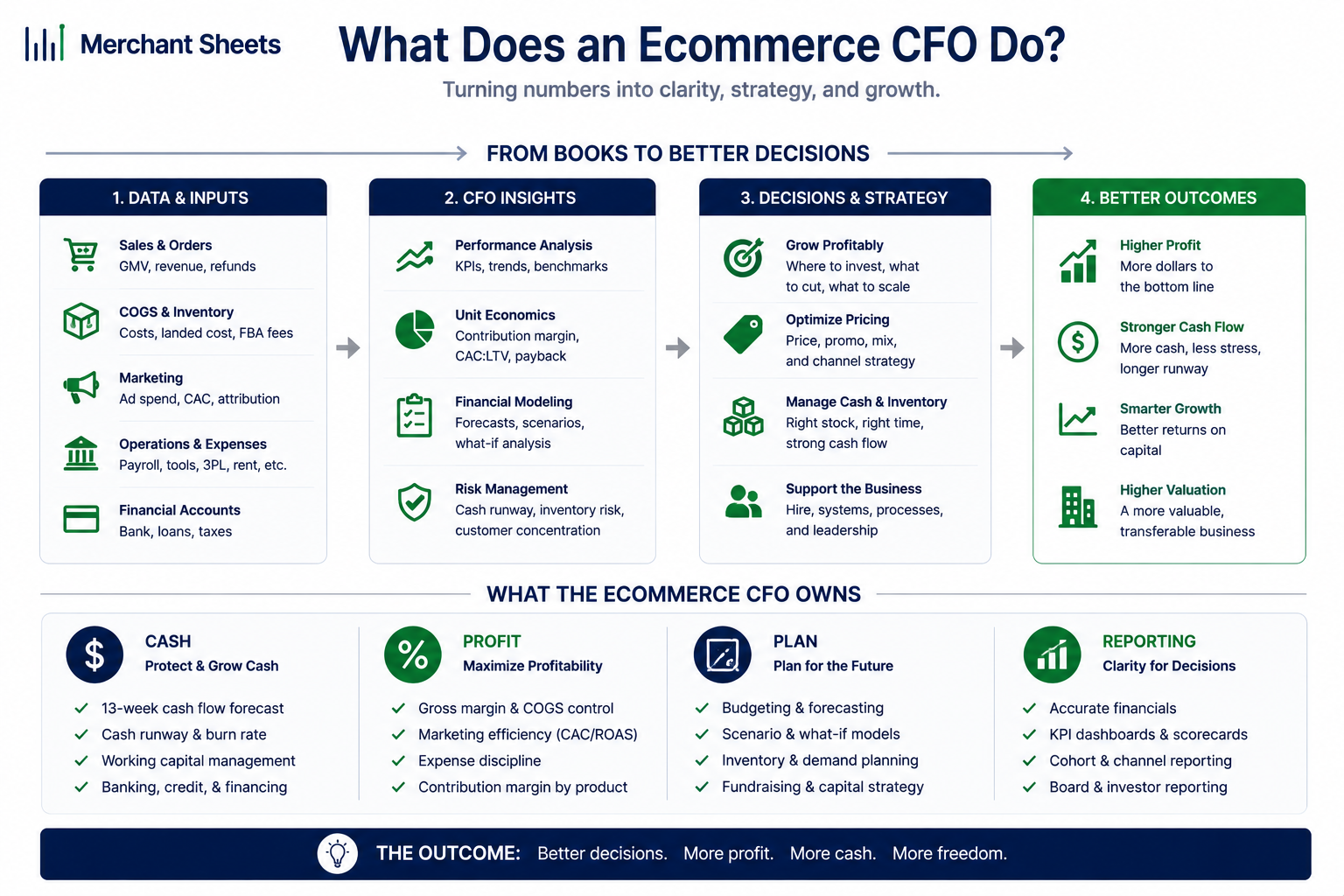
Whatever the arrangement, the work sorts into four things an ecommerce CFO owns: your cash, your profit, your plan, and your reporting.
Table 1. What an ecommerce CFO owns, and the deliverable you get from each.
| What they own | What that means | The deliverable you get |
| Cash | Cash flow and working capital, including inventory-to-cash timing | A rolling 13-week cash forecast, updated monthly |
| Profit | Unit economics and pricing by channel and SKU | Contribution margin, CAC, and MER split by channel and SKU |
| Plan | Forecasting, budgeting, scenario planning, and financing | A driver-based forecast and scenario models behind each decision |
| Reporting | The monthly pack, KPIs, and investor readiness | A report that says what happened and what to do next |
What makes an ecommerce CFO different from a regular CFO?
A general CFO and an ecommerce CFO share the fundamentals. The difference is the handful of ecommerce-specific economics an ecommerce CFO works in every day:
- Channel-level margin: They split profit across DTC, Amazon, and wholesale, because a blended margin can look healthy while one channel loses money on every unit.
- Inventory as cash: They treat stock as the biggest use of your cash, timing reorders and financing around the cash you’ll have, rather than around demand alone.
- Platform fee mechanics: They model Amazon FBA and referral fees plus pay-per-click (PPC) ads, along with Shopify Payments and app costs, down to the unit.
- Ad-spend efficiency: They watch contribution margin after ad spend, CAC, and MER by channel, so a jump in revenue doesn’t quietly cost you profit.
- Settlement and payout timing: They plan around Amazon’s roughly two-week disbursements and processor holds, which a profit-and-loss statement hides but your bank balance feels.
- Sales tax exposure: They track where you’ve built economic nexus as you grow across states and channels, and flag it before it turns into a liability.
Owns your cash forecast and working capital
The first responsibility, and the one a growing brand feels first, is cash. An ecommerce CFO builds and maintains a rolling 13-week cash forecast, a week-by-week view of the money coming in and going out, so you can see a shortfall before it lands and time your inventory buys around it.
For an online business, that forecast has to handle sales by channel, Amazon disbursements and card-processor payouts on their real timing, ad spend, payroll, and the big lumpy item: deposits and balance payments to your suppliers.
Underneath the forecast sits your working capital, which an ecommerce CFO manages through the cash conversion cycle, how long your cash is tied up between paying for stock and collecting on the sale. For an inventory business, that’s where cash lives or dies.
A brand can be growing on paper and still cash-tight, because every dollar of profit is going straight back into more stock.
The CFO’s job is to model that cycle and decide how much growth your cash can safely fund, and when to pull financing in instead. On a 60-day inventory lead time, an order placed today ties up cash for two months before a single unit sells, so the timing of that buy is a cash decision as much as a demand one.
Owns your unit economics by channel and SKU
The second responsibility is knowing whether each channel and each product makes money, rather than only whether the business does overall.
An ecommerce CFO measures contribution margin, what a sale leaves after the costs that rise with each order, along with customer acquisition cost (CAC), what it costs to win one paying customer, and MER, total revenue divided by total ad spend.
They track all three by channel and by SKU, because a single blended number hides your losers.
The ecommerce detail is where this gets real. On Amazon, a SKU’s true margin only shows once FBA fees, referral fees, returns, and PPC come out. On your own site, it’s COGS (the direct cost of the goods sold), shipping, payment fees, and the ad cost that won the order.
An ecommerce CFO sets pricing off these numbers too, deciding which products can carry a promotion and which are quietly underwater.
A $40 product can look profitable on your site and lose money on Amazon once a $6 FBA fee, a 15% referral fee, and PPC come out. This is the layer that turns contribution margin by channel and CAC by channel from reports into pricing and spending decisions.
| Blended margin can look healthy while your Amazon channel loses money on every unit after FBA fees and PPC. An ecommerce CFO splits margin by channel and SKU so you can see it. |
Owns your plan: Forecasting, scenario planning, and financing
The third responsibility is the forward look. An ecommerce CFO runs a driver-based budget and forecast, then builds scenario models that put a number on a decision before you commit to it.
The decisions are the ones that keep you up: a large inventory buy, a new hire, a price change, a push into a new channel. Each one gets modeled against the cash plan, so the answer is a figure you can act on rather than a gut call.
Financing is where the plan and the cash meet. An ecommerce CFO models a line of credit, an SBA loan, or inventory or revenue-based financing against the forecast, so you borrow to fund a real gap rather than to paper over one.
This is also the person who builds the underlying financial model in the first place, and keeps the scenario planning current as the numbers move. Done well, it means you’re funding growth you’ve already stress-tested, and turning away the growth you can’t.
Owns your reporting: The monthly pack and investor readiness
The fourth responsibility ties the rest together. Each month, an ecommerce CFO produces a management pack: the KPIs that matter for your brand, a plain read on what happened, and a short list of what to do next. That’s the difference between a stack of statements and a document you can make decisions from.
The rhythm is monthly and anchored to your close: once the books are shut, the CFO refreshes the models and reports on what moved and why. The core metrics are contribution margin by channel, CAC and MER, the LTV:CAC ratio, the cash conversion cycle, and inventory turns, the ecommerce KPIs that matter for a brand your size.
When the stakes rise, the reporting scales up with them. If you’re raising money, taking on debt, or heading toward a sale, an ecommerce CFO handles getting the numbers investor-ready: building the model, assembling the data room, and sitting in the room for the hard questions.
It’s the same discipline as the monthly pack, aimed at an outside audience, and it’s a common reason brands bring a CFO in before a capital event.
Where an ecommerce CFO fits alongside your bookkeeper and accountant
It helps to place the role against what you already pay for. A bookkeeper records and reconciles your transactions. An accountant or controller closes the books each month and produces accurate statements. An ecommerce CFO uses those statements to decide on cash, pricing, inventory, and growth.
Each role sits on top of the one before it, and most brands add them in that order as they scale.
The practical point: an ecommerce CFO works from clean books, so the role assumes a bookkeeper and accountant are already in place. For the full side-by-side, see how the roles compare in bookkeeper vs accountant vs CFO, and where a fractional CFO vs an in-house hire makes sense.
Do you need an ecommerce CFO, and can it be remote or fractional?
Most ecommerce brands don’t need a full-time CFO. They need CFO-level thinking on the big decisions, which is why the common route under roughly $10M is a fractional or remote CFO, part-time and ongoing.
A full-time ecommerce CFO costs $350,000 or more all-in once salary, bonus, and benefits are counted as of 2026, while fractional or remote help gives you the same senior judgment for a fraction of that.
The work travels well, too, since the numbers live in cloud tools like QuickBooks, Xero, and your sales channels.
Be honest with yourself about stage. A brand under about $1M is often better served by hourly advice or a one-time audit than a standing retainer.
The plain signal that it’s time to look: you’re making six-figure calls on inventory and ad spend, cash feels tight despite growth, or a raise is on the horizon.
For the full checklist, see when to hire a fractional CFO, and we keep the numbers in the full pricing breakdown.
Frequently asked questions
What does an ecommerce CFO do?
An ecommerce CFO owns the financial strategy of an online business: cash flow and the 13-week forecast, profitability by channel and SKU, forecasting and scenario planning, financing decisions, and the monthly reporting that turns the numbers into what to do next.
What's the difference between an ecommerce CFO and a regular CFO?
An ecommerce CFO does the same core CFO work but centers it on ecommerce economics, channel-level contribution margin, inventory-to-cash timing, Amazon and Shopify fee mechanics, and ad-spend efficiency, which a generalist CFO usually isn’t set up to model.
Does an ecommerce CFO do bookkeeping or accounting?
No, an ecommerce CFO works from clean books rather than producing them: a bookkeeper records transactions, and an accountant closes the month, while the CFO uses those statements to make decisions on cash, pricing, inventory, and growth.
How much does an ecommerce CFO cost?
A fractional ecommerce CFO commonly runs a few thousand dollars a month on a retainer as of 2026, with hourly and one-time-audit options for smaller brands, far below the $350,000-plus all-in cost of a full-time hire.
Can an ecommerce CFO work remotely or fractionally?
Yes, most ecommerce CFO work is done remotely and part-time: the numbers live in cloud tools like QuickBooks, Xero, and your sales channels, so a fractional or remote CFO can own cash, margin, and reporting without being in-house.
Do I need a CFO for my ecommerce business?
You likely need one once you’re making six-figure decisions on inventory, ad spend, and pricing, and your bookkeeper is being asked strategy questions, though a brand under about $1M is often better served by hourly advice or a one-time audit first.
What KPIs does an ecommerce CFO track?
An ecommerce CFO tracks contribution margin by channel and SKU, CAC and MER, the LTV:CAC ratio, the cash conversion cycle, inventory turns, and the 13-week cash position- metrics that show whether growth is making money or draining cash.
Get a senior CFO on your ecommerce numbers
Now you know what the role covers. If you want a senior CFO doing this on your numbers, your DTC and Amazon margins, the 13-week cash plan, and the monthly call, that’s the work I do as your fractional ecommerce CFO.
