
Key takeaways
- Spreadsheets stay an excellent analysis and modeling surface as you grow; what a scaling brand outgrows is using them as the system of record and the manual data pipeline.
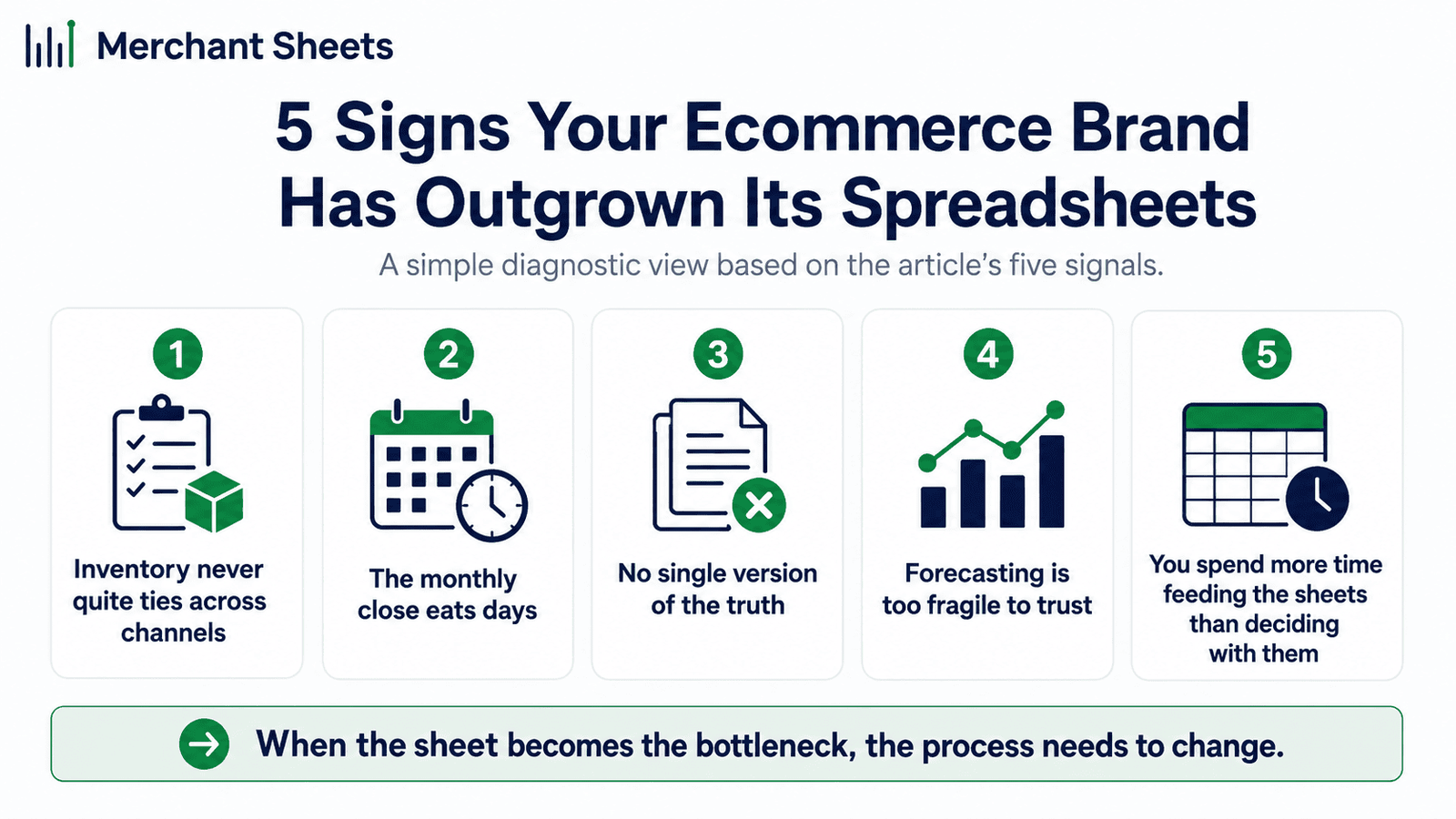
- The five signs: inventory that never quite ties across channels, a monthly close that eats days, no single version of the truth, forecasting that’s too fragile to trust, and more time feeding the sheets than deciding with them.
- Most of the pain shows up in operations and inventory first, then in finance, which is why the signs blend both.
- The fix is two-part: a data foundation underneath, so numbers stop being hand-keyed, and senior judgment on top, so someone owns the analysis.
- Buying software doesn’t fix a judgment gap, and hiring a CFO doesn’t fix a data-plumbing gap, so name which one you have before you spend.
- Even after you add systems and a CFO, the modeling, scenarios, and board reporting still live in spreadsheets, now fed by clean data.
Spreadsheets don’t break because they’re spreadsheets. They break when a growing ecommerce brand asks them to be the system of record for inventory, orders, and cash, all kept current by hand across two or three channels.
That’s the job a spreadsheet outgrows. Here are five signs you’ve hit that point, and what to do about it.
What does outgrowing spreadsheets really mean?
Outgrowing spreadsheets means the spreadsheet has quietly become your system of record, the single place inventory, orders, and cash officially live, and your data pipeline, the manual copy-and-paste between channels and tools.
At volume, that role starts to fail. The spreadsheet is still a fine place to analyze and model; the part that breaks is the record-keeping and the plumbing.
It helps to see a spreadsheet as two tools in one file. It’s an analysis surface, where you build margins, forecasts, and scenarios, and it’s a database, where numbers get stored and maintained. When a brand is small, one file does both jobs well.
As channels and volume grow, the database job breaks first: the numbers drift, the versions multiply, and the close drags. The analysis job stays as valuable as ever.
The table below sorts what you keep from what you’ve outgrown before we get to the signs, each of which is the record-keeping or the plumbing starting to give way.
Table 1. What you outgrow, and what you keep (as of 2026).
| The spreadsheet’s job | What happens as you scale | Verdict |
| System of record (inventory, orders, cash ledger) | Manual entry can’t keep up with multichannel volume, so numbers drift | Outgrown: move the record to connected systems |
| Data pipeline (copy-and-paste between channels and tools) | Hours of manual consolidation, version sprawl, and errors creep in | Outgrown: automate the flow so data lands on its own |
| Analysis and modeling (margin, forecasts, scenarios, board reporting) | Still the fastest, most flexible place to think and decide | Keep: the analysis stays in spreadsheets, even with a CFO |
Sign 1: Your inventory numbers are never quite right
The first sign is operational. Your stock counts don’t tie, because one spreadsheet is trying to track units across Shopify, Amazon (including inventory sitting in Fulfillment by Amazon), and maybe a warehouse or a third-party logistics provider (3PL), all updated by hand.
Every channel moves at its own pace, and the spreadsheet is always a few hours or a few days behind reality.
The result is the quiet tax of bad inventory data: you oversell an item and cancel orders, or you hold too much of another and tie up cash you needed elsewhere. When someone asks how many units of a stock keeping unit you have right now, the honest answer is a shrug and a recount.
That’s a system-of-record problem, and it grows with every channel you add. Getting the underlying discipline right is its own topic, covered in inventory planning; the point here is that a hand-updated sheet stops being able to hold the truth.
Sign 2: The monthly close and reporting eat days
The second sign is where finance and operations meet. Closing the books and producing your monthly reporting takes days, and the numbers still don’t fully tie.
For an ecommerce brand the work is heavier than it looks: a single Amazon payout bundles two weeks of sales, refunds, and a dozen fee types into one deposit, and someone has to reconcile that back to the bank by hand, keep cost of goods sold (COGS) and inventory entries current, then rebuild the same report from scratch the next month.
Slow reporting has a real cost, because a number you get three weeks after month-end is a number you can no longer act on. By the time the picture is clear, the decision it should have informed has already passed.
When the close is a multi-day manual scramble every month, the spreadsheet has become the bottleneck. The mechanics of doing this well are covered in how ecommerce accounting works; the sign to watch for is the close getting longer as you grow.
A close that took an afternoon at six figures can take a week at eight, and the extra days are pure manual effort.
Sign 3: Nobody’s sure which version is the truth
The third sign is data integrity. There are three copies of the model, two of them have broken links, and the file everyone opens is named something like final_v3. Two people quote two different numbers in the same meeting, and both are reading from a real spreadsheet.
This is more dangerous than it is annoying, because decisions get made on whichever file happened to be open.
Spreadsheets are also error-prone at scale in a way that’s well documented: research into spreadsheet accuracy has long found that most complex ones contain at least one error, and a single wrong cell reference can move a number that nobody catches. None of that is a knock on your team.
It’s what happens when one shared file becomes the source of truth for a business that now has real volume and several people touching the numbers.
When you can’t point to one version and trust it, you’ve outgrown the spreadsheet as the record. The risk compounds as more people touch the file, since every new hand is another chance for an untracked change.
Sign 4: You can’t answer forward-looking questions fast
The fourth sign is analytical. The spreadsheet can tell you what happened last month, but it buckles on the forward-looking questions that drive decisions. How many weeks of cash do we have if we place this inventory buy?
What’s our margin by channel and by stock keeping unit (SKU) this month? What happens to runway if we scale the ad account by half?
When the answer to each of those is a day of rebuilding a brittle model that only one person understands, the modeling has outgrown the setup. This is worth saying carefully, because the modeling itself belongs in a spreadsheet; the problem is that it’s being rebuilt by hand on top of data that arrives late and dirty.
Solid forward work, like a cash flow forecast or an ecommerce financial model, depends on clean inputs flowing in reliably. When those inputs are the bottleneck, the analysis suffers even though the tool is the right one. The tell is that the questions you most need answered are the ones that take longest to answer.
Sign 5: You spend more time feeding the sheets than deciding with them
The fifth sign is the one that ties the rest together. The founder or the finance person is spending more hours maintaining the spreadsheets, keying data, reconciling channels, chasing down why two tabs disagree, than using them to make decisions.
The tool that was supposed to give you leverage has become a second job. Founders describe it as running the business twice, once in reality and once in the spreadsheet, then reconciling the two.
The cost here is what doesn’t get done. The senior judgment your business needs, on pricing, on cash, on which product line to push, gets crowded out by data entry.
When the plumbing has become the work, you need two things: the plumbing automated so the data maintains itself, and the judgment resourced so someone senior is deciding with it. That’s the fix, and it’s next.
What to do about it
The move isn’t to rip out your spreadsheets. It’s to take the two jobs off them that they’ve outgrown and leave them the one they’re great at. Underneath, put a data foundation: connected systems that hold the record and feed the numbers in, such as your accounting software, a channel or inventory system, and an integration like A2X to handle the payouts, so the data stops being hand-keyed.
On top, put senior judgment: a person who owns the analysis and the decisions, which for most growing brands is a fractional CFO rather than a full-time hire. The fractional CFO guide covers how that model works if it’s new to you.
The important diagnostic is to name which gap you have before you spend. New software (an enterprise resource planning, or ERP, system, say) fixes data that won’t stay accurate and current, and a senior hire fixes decisions that need judgment. One doesn’t fix the other.
And here’s the reassuring part, because the spreadsheets you rely on aren’t going anywhere: even after the systems and the senior person are in place, the modeling, the scenarios, and the board reporting still live in spreadsheets, now fed by clean data instead of manual entry.
For the timing of that senior layer, see when to bring in a fractional CFO, and for what the role covers day to day, see what that senior layer handles.
Frequently asked questions
What are the signs you've outgrown spreadsheets?
You’ve outgrown spreadsheets when your inventory never quite ties across channels, the monthly close eats days, no one’s sure which file is the truth, forecasting is too fragile to trust, and you spend more time feeding the sheets than deciding with them.
Are spreadsheets bad for a growing ecommerce business?
No, spreadsheets are an excellent analysis and modeling tool at any size; what a growing brand outgrows is using them as the system of record for inventory, orders, and cash kept current by hand across multiple channels.
Do you still use spreadsheets after hiring a CFO?
Yes, a fractional CFO does much of the modeling, scenario work, and board reporting in spreadsheets, so the goal is to feed those spreadsheets from clean, connected data rather than to replace them.
When should an ecommerce business move off spreadsheets for inventory?
Move the inventory record to connected software once you’re selling across multiple channels at a volume where manual updates can’t keep counts accurate, which is usually where overselling and stockouts start showing up.
Should I buy an ERP or hire a CFO?
A small ecommerce brand under about $1M usually starts with hourly advice or a one-time profit and cash audit rather than a retainer, then moves to a light monthly retainer around $2,000 to $5,000 as revenue grows past $1M to $2M.
Is Excel or Google Sheets enough to run an ecommerce business?
Excel or Google Sheets is enough for the analysis and light record-keeping of a smaller single-channel brand, but as channels and volume grow the record-keeping and data-consolidation jobs outgrow a spreadsheet and need connected systems underneath.
What's included in a fractional CFO's monthly fee?
A monthly fee usually covers a maintained cash model and forecast, unit-economics and KPI reporting, and a regular call, while a one-time model build, dashboard, or fundraise support is often a separate project fee, so confirm the scope before you sign.
Keep the spreadsheets, fix what’s under them
If those signs sound like your week, the first move isn’t a big software project. It’s getting your numbers reliable and figuring out what to fix in what order.
That’s what I do in a fixed-scope profit and cash audit: I work through your real data, tell you where the gap is systems and where it’s senior judgment, and hand you a plan you can act on.
The spreadsheets you like stay; they go back to helping you decide instead of holding you back. Tell me where it hurts most, and we’ll start there.
