
Key takeaways
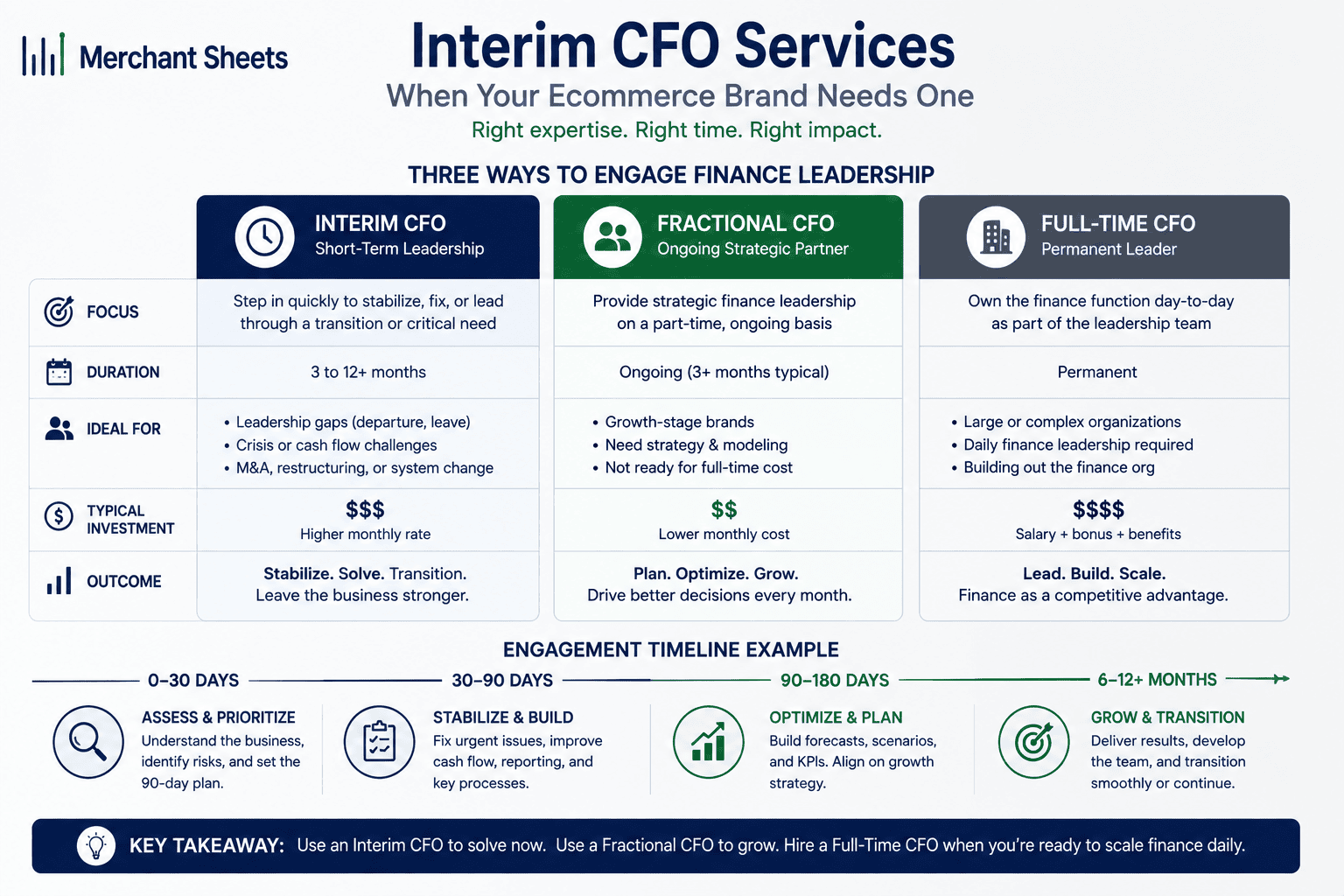
- An interim CFO is a senior finance leader who steps in full-time for a defined period, usually three to six months, to cover a gap such as a departed CFO, a live deal, or a cash crisis.
- A fractional CFO is ongoing part-time help; an interim CFO is temporary full-time cover. The difference is duration and time commitment, and the seniority is similar.
- Brands typically need an interim CFO when a finance leader leaves suddenly, during a merger or sale, during a fundraise with the seat empty, or when a turnaround needs full-time attention now.
- Interim CFO engagements in 2026 run roughly $15,000 to $35,000 a month full-time, against about $5,000 to $15,000 a month for ongoing fractional help and $300,000-plus a year all-in for a permanent hire.
- For most ecommerce brands under about $5M, the gap is bridged by a fractional CFO or a fixed-scope project, and a full-time interim seat fits a larger or more urgent gap.
- An interim CFO’s first job is to stabilize: reliable cash reporting, a near-term cash forecast, and board or lender numbers that hold up, then a clean hand-off to whoever comes next.
An interim CFO steps in full-time to run finance for a few months while you fill a gap. A fractional CFO is ongoing part-time help you keep on the roster. People search for one and mean the other. Here’s what an interim CFO does, what it costs, and which one your ecommerce brand needs right now.
What is an interim CFO?
An interim CFO is a senior finance executive who takes over the chief financial officer (CFO) role full-time for a defined, temporary period, usually three to six months, to cover a gap such as a departed CFO, a merger, or a cash crisis. They run the day-to-day of finance and the strategy, then hand off and step out. The engagement has a built-in end date and a clean exit.
An interim CFO is defined by two things: the role is temporary, and the commitment is full-time. That combination is what separates it from the other ways to bring in senior finance help, and it’s why the term gets tangled up with a fractional CFO, which is the next section. You’ll also see “temporary CFO” used for the same arrangement.
In practice the interim CFO becomes your acting finance lead for the stretch: they own the monthly close, sit in on board and lender calls, manage whatever finance staff you have, and carry the decisions a permanent CFO would, with the seat theirs only until the gap closes.
For the full run of responsibilities the seat covers, what an ecommerce CFO handles breaks the role down week by week.
Interim CFO vs fractional CFO: what’s the difference?
An interim CFO is temporary and full-time: they fill a seat for a few months, then leave. A fractional CFO is ongoing and part-time: a senior person who works with you a few days a month, for as long as you need the help. The level of experience is similar in both. What differs is how long they stay and how much of their week you get.
The two fit different situations. An interim CFO suits a sudden gap that needs full-time attention now and a clean exit later, such as a resignation or a live deal.
A fractional CFO suits a brand that wants senior judgment on a continuing basis and can’t justify a full-time hire yet, which is the fractional CFO model most growing brands land on.
Per hour the rates are close; the monthly difference comes from the number of hours committed, so a full-time interim engagement costs more per month even when the hourly rate matches.
The practical read is that you’re paying for availability: an interim CFO clears the calendar for you, while a fractional CFO spreads a few days a month across several brands by design.
Table 1. Interim CFO vs fractional CFO vs full-time CFO (as of 2026).
| Interim CFO | Fractional CFO | Full-time CFO | |
| Time commitment | Full-time, temporary | Part-time, a few days a month | Full-time, permanent |
| Typical duration | 3 to 6 months (up to 12) | Ongoing, months to years | Indefinite |
| Best for | A sudden gap that needs cover now | Ongoing senior judgment without a full hire | A large, complex finance function |
| Typical cost (2026) | ~$15,000 to $35,000 a month | ~$5,000 to $15,000 a month | $300,000-plus a year all-in |
| Exit | Built in; hands off and leaves | Open-ended; scale up or down | Permanent role |
When does a brand need an interim CFO?
A brand needs an interim CFO when a finance leader leaves and the work can’t wait, when a deal or a raise needs a full-time hand on the numbers, or when a cash crisis needs senior attention right away. The common thread is a real gap with a clock on it, where part-time help won’t close it fast enough and a permanent hire won’t arrive in time.
The situations that trigger it are specific. A CFO or controller (the senior manager who runs the accounting function and the monthly close) resigns, and the close, the cash, and the reporting still have to happen.
A merger, acquisition, or sale gets underway and needs due-diligence-ready numbers plus someone to run the process. A fundraise or a lender review goes live with the finance seat empty.
Cash gets tight and a turnaround needs full-time senior focus. A new accounting or enterprise resource planning (ERP) system, or a broken monthly close, needs a steady hand through the transition.
Or an existing finance leader goes out on parental or medical leave and the seat needs covering.
A brand that wants ongoing senior help, with no gap and no deadline, is describing a fractional CFO, and the timing of that decision is its own question covered in when to bring on ongoing help. The table below sizes the typical interim situations and how long each usually runs.
Table 2. Situations that call for an interim CFO, and how long they usually run (as of 2026).
| Situation | What’s happening | Typical length |
| CFO or controller departure | The finance lead left and the close, cash, and reporting can’t pause | 3 to 6 months, until the permanent hire lands |
| Merger, acquisition, or sale | A deal needs clean, due-diligence-ready numbers and someone to run it | 3 to 6 months around the deal |
| Fundraise or lender process | A raise or credit facility is live with the CFO seat empty | 3 to 4 months through the close |
| Cash crunch or turnaround | Cash is tight and the situation needs full-time senior attention now | 3 to 6 months to stabilize |
| Systems or close overhaul | A new accounting or ERP system, or a broken close, needs a steady hand | 3 to 6 months through the transition |
| Leave cover | An existing finance leader is out on parental or medical leave | 3 to 6 months, matched to the leave |
What an interim CFO does in the first weeks
An interim CFO stabilizes first and steers second. The opening priority is getting reliable numbers in front of the people who depend on them: an accurate cash position, a near-term cash forecast, a clear read on what’s owed and owing, and board or lender reporting that holds up under questions.
Until those numbers are trustworthy, no strategic call resting on them is safe to make.
For a Shopify and Amazon brand, that early cleanup has a familiar shape. It usually means reconciling channel payouts back to the bank, getting cost of goods sold (COGS) and inventory current, and building a thirteen-week cash forecast (a rolling week-by-week view of cash in and out) that respects seasonality and the timing of inventory buys.
Once the foundation is solid, the interim CFO moves to the reason they were brought in, whether that’s margin and pricing, the deal, the raise, or the turnaround.
The full week-to-week of that top layer is covered in what an ecommerce CFO handles, and the cash piece specifically in a thirteen-week cash forecast. A good interim CFO also documents what they build, so the permanent or fractional CFO who follows inherits a working close, a live forecast, and clean reporting instead of a fresh start.
How much do interim CFO services cost?
In 2026, a full-time interim CFO runs roughly $15,000 to $35,000 a month, with the higher end for emergency, deal, and turnaround work. Ongoing fractional help runs about $5,000 to $15,000 a month. A permanent CFO costs $300,000-plus a year all-in once you count benefits, bonus, and equity.
A six-month interim engagement often lands near half the annualized cost of a permanent hire, and it skips the recruiting fee, the severance risk, and the equity grant.
What moves the number is urgency, the complexity of the deal or the situation, and how many hours a week the work really takes. Per hour, interim and fractional rates sit close together, so the gap in the monthly figure reflects full-time versus part-time commitment more than a difference in the person.
For how the ongoing fractional numbers break down by engagement type, our fractional CFO pricing guide covers the ranges in detail. Treat every figure here as a 2026 range to verify against real quotes, since rates move with the market and the specifics of your brand.
Most interim engagements are billed as a monthly retainer for a set number of days, sometimes with a short minimum term, so the cost stays predictable across the length of the gap.
Do you need an interim CFO, or a fractional one?
For most ecommerce brands under about $5M, a full-time interim seat at $20,000-plus a month is more than the gap needs. At that size the practical bridge is usually ongoing fractional help or a fixed-scope project, and a true interim seat earns its cost at a larger or more urgent stage, where a full finance function has to keep running without its leader.
A $2M direct-to-consumer brand whose bookkeeper leaves rarely needs a $25,000-a-month executive to keep the books moving; it needs the close covered and a forecast built, which a fixed-scope engagement handles for a fraction of that.
The useful move is to match the engagement to the gap rather than the label. If a finance leader left and the close and cash genuinely can’t wait, a short interim-style engagement makes sense.
If the gap is a live deal or a one-time cleanup, a fixed-scope project fits the shape of the work. If the need is ongoing senior judgment with no deadline, that’s a fractional CFO.
Where a controller or a full-time hire fits the picture is its own comparison, covered in where a controller or full-time hire fits. Getting that match right is what keeps you from paying full-time interim rates to solve a part-time problem.
Frequently asked questions
What is an interim CFO?
An interim CFO is a senior finance executive who takes over the CFO role full-time for a defined, temporary period, usually three to six months, to cover a gap such as a departed CFO, a deal, or a cash crisis, then hands off and steps out.
What's the difference between an interim CFO and a fractional CFO?
An interim CFO is temporary and full-time and fills a seat for a few months, while a fractional CFO is ongoing and part-time and works with you a few days a month indefinitely, so the difference is duration and time commitment rather than seniority.
How long does an interim CFO engagement last?
Most interim CFO engagements run three to six months, occasionally up to twelve, long enough to cover the gap or transition and hand off to a permanent or fractional replacement.
How much does an interim CFO cost?
A full-time interim CFO in 2026 runs roughly $15,000 to $35,000 a month depending on urgency and complexity, which is often about half the annualized cost of a permanent CFO and two to three times the monthly cost of ongoing fractional help.
When should you hire an interim CFO?
Hire an interim CFO when a finance leader leaves suddenly, when a merger, sale, or fundraise needs full-time attention on the numbers, or when a cash crisis needs senior judgment immediately and the work can’t wait for a permanent hire.
Is an interim CFO the same as a temporary CFO?
Yes, interim CFO and temporary CFO mean the same thing: a senior finance leader brought in full-time for a defined period to cover a gap, then hand off.
Does a small ecommerce business need an interim CFO?
Usually not a full-time interim seat, because for most brands under about $5M the gap is bridged more affordably by a fractional CFO or a fixed-scope project, though a short interim-style engagement can make sense when a finance leader has left and the close and cash can’t wait.
Cover the gap without overhiring
If a finance leader has left, a deal is live, or cash is tight, you don’t have to wait for a permanent hire to get a steady hand on the numbers.
For most brands your size, the practical bridge is a fixed-scope engagement I can step into fast, starting with a profit and cash audit that gets your cash position, forecast, and reporting reliable in weeks.
If the gap really does call for a full-time interim seat, I’ll say so and point you to the right fit. Tell me what the gap is, and we’ll scope the right-sized fix.
